Back to: ASIS CPP preparation course
0
Lesson 1.1: Planning, Organization, and Control
Goal: To understand how to structure a security department that aligns with business goals and manages resources effectively.
Learning Objectives:
- Differentiate between Strategic, Operational, and Tactical planning.
- Understand the four functions of management (PODC).
- Identify the proper placement of security within an organizational hierarchy.
Key Terms:
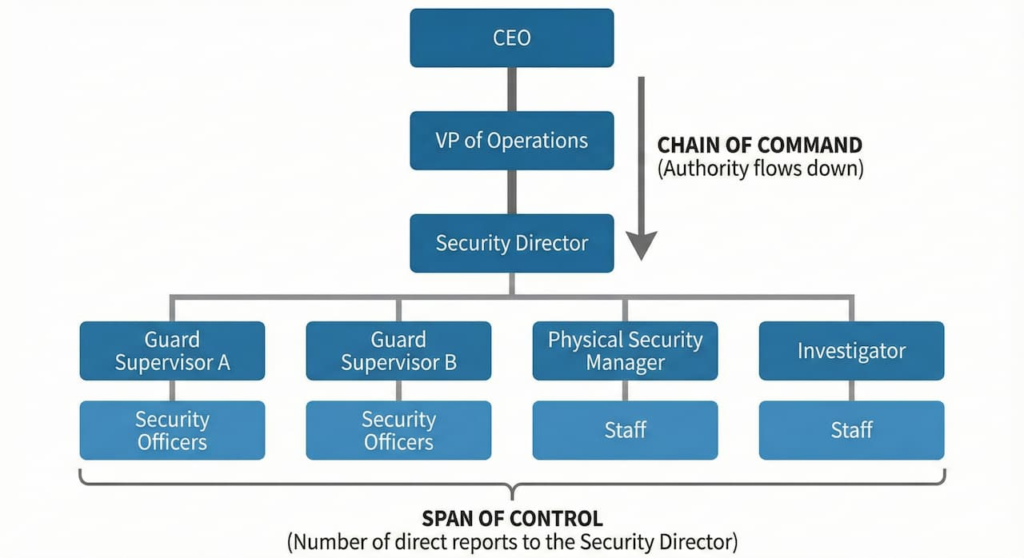
- Span of Control: The number of subordinates a supervisor can effectively manage.
- Unity of Command: The principle that an employee should report to only one supervisor.
- Chain of Command: The line of authority and responsibility along which orders are passed.
Core Content:
- The Management Cycle (PODC):
- Planning: Setting goals and deciding how to achieve them (e.g., Budgeting, Policy creation).
- Organizing: Grouping resources and activities (e.g., Staffing, Structure).
- Directing (Leading): Guiding and motivating staff (e.g., Training, Coaching).
- Controlling: Measuring performance against goals (e.g., Audits, KPIs).
- Organizational Structure:
- Security should report to a senior executive to ensure independence and authority (ideally the CEO, COO, or General Counsel—not HR or Facilities, ideally).
- Proprietary Security: In-house employees (Better loyalty/control, higher cost).
- Contract Security: Outsourced (Flexibility, lower admin burden, potential turnover issues).
- Hybrid: A mix of both (often the most effective).