Back to: ASIS PCI Study Guide
Lesson 3: Criminal vs. Civil vs. Administrative Investigations
Lesson Objective:
By the end of this lesson, you will be able to distinguish between the three primary types of investigations. You will understand how the Burden of Proof, Rules of Evidence, and Investigator Authority shift depending on the venue.
1. The Three Investigative Venues
An investigator must immediately identify which “lane” they are operating in, as this dictates the rules of engagement.
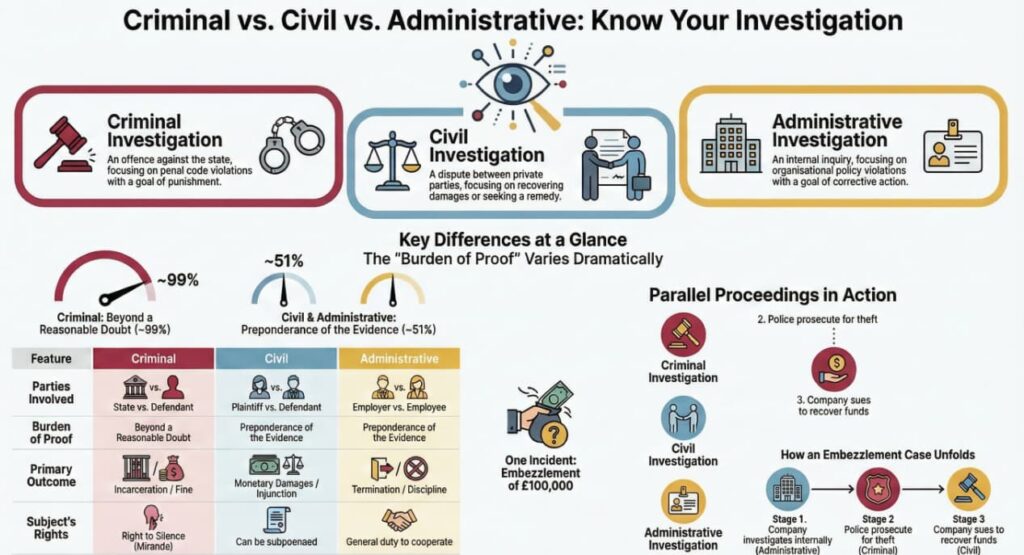
A. Criminal Investigations
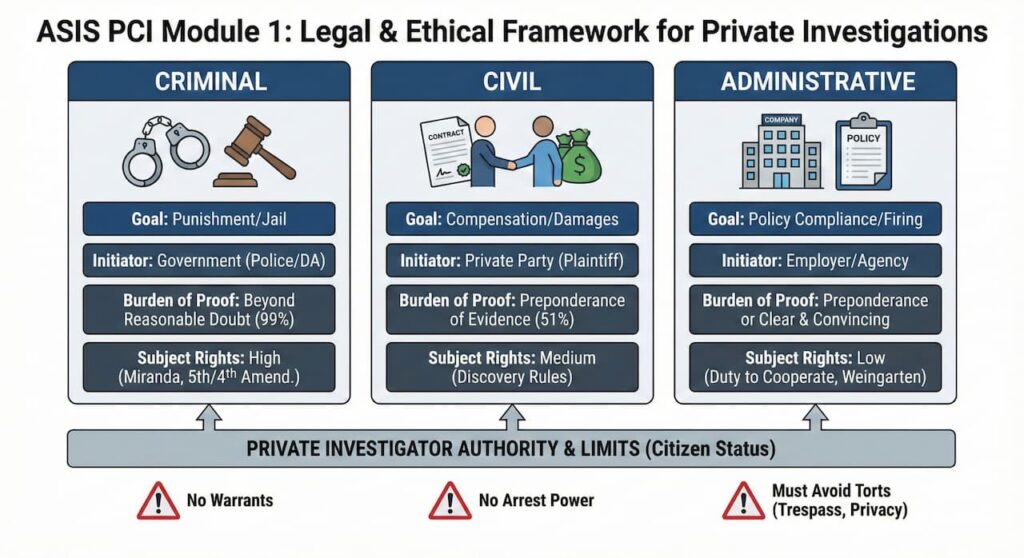
- Focus: Violations of government penal codes (theft, assault, fraud) considered an offense against the state/society.
- Initiator: The Government (Prosecutor/Crown).
- Goal: Punishment (Incarceration, fines, probation).
- Investigator Role: Usually Law Enforcement (LE). Private investigators typically get involved here only as defense investigators (working for the accused) or to package a preliminary case to hand over to LE.
- Key Restriction: Private investigators do not have special powers of arrest or the ability to execute search warrants.
B. Civil Investigations
- Focus: Disputes between private parties (individuals or corporations). Examples include breach of contract, negligence (torts), intellectual property theft, or asset recovery.
- Initiator: The Plaintiff (the victim).
- Goal: Remedy (Monetary damages, injunctions, return of property).
- Investigator Role: Highly active. This is the “bread and butter” of many private investigators.
- Key Restriction: You cannot compel cooperation. You rely on public records, surveillance, and voluntary interviews.
C. Administrative (Internal) Investigations
- Focus: Violations of organizational policies, procedures, or codes of conduct. Examples include sexual harassment, internal fraud, or substance abuse at work.
- Initiator: The Employer / Organization.
- Goal: Administrative action (Termination, suspension, reprimand, policy change).
- Investigator Role: Corporate security or external consultants act as fact-finders for HR/Legal.
- Key Restriction: Employees generally must cooperate as a condition of employment (subject to labor laws), but you cannot detain them.
2. The Burden of Proof
The “Burden of Proof” is the level of certainty required to “win” the case. This is a critical concept for the PCI exam.
- Beyond a Reasonable Doubt (Criminal): The highest standard. The evidence must be so convincing that no reasonable person would question the defendant’s guilt. (Think ~98-99% certainty).
- Preponderance of the Evidence (Civil/Administrative): The standard for most civil and internal cases. You only need to prove that it is “more likely than not” that the event occurred. (Think ~51% certainty).
- Clear and Convincing Evidence: A middle ground sometimes used in civil cases (like fraud) or administrative hearings where the stakes are high (e.g., revoking a professional license).
3. Comparative Analysis: Key Differences
| Feature | Criminal | Civil | Administrative |
| Parties | State vs. Defendant | Plaintiff vs. Defendant | Employer vs. Employee |
| Burden of Proof | Beyond Reasonable Doubt | Preponderance of Evidence | Preponderance / Policy Violation |
| Subject Rights | Miranda (Right to Silence), Counsel | No Right to Silence (can be subpoenaed) | Duty to Cooperate (in most private sector) |
| Outcome | Jail / Fine | Money / Injunction | Firing / Discipline |
| Evidence Rules | Strict (Exclusionary Rule applies) | Variable (Discovery rules apply) | Relaxed (Hearsay often allowed) |
4. Parallel Proceedings
Often, a single incident triggers all three investigations simultaneously.
- Example: An employee embezzles $100,000.
- Administrative: The company investigates and fires the employee (Employment Law).
- Criminal: The company files a police report; the D.A. prosecutes for Grand Larceny (Penal Code).
- Civil: The company sues the ex-employee to recover the stolen money (Civil Tort).
PCI Strategy Note: In parallel proceedings, the Administrative investigation usually happens first (to stop the loss). However, investigators must be careful not to promise “immunity” from criminal prosecution in exchange for a confession during the internal interview.
5. Special Concept: The “Upjohn” Warning
In US-based corporate investigations (and widely adopted as best practice globally), this is the “Corporate Miranda.”
When interviewing an employee in an internal investigation, you must clarify:
- You represent the company, not the employee.
- The privilege (confidentiality) belongs to the company.
- The company may choose to share the interview notes with law enforcement.
Failure to give this warning can ruin the company’s ability to use the interview in court.
Lesson Summary
- Criminal: High stakes (jail), high burden of proof, strict rights.
- Civil: Monetary disputes, lower burden (51%).
- Administrative: Policy violations, employment consequences, duty to cooperate.
- Always know which hat you are wearing. Using “police tactics” in an administrative interview can lead to lawsuits; using “administrative shortcuts” in a criminal case can get evidence thrown out.
Knowledge Check
(Self-Assessment)
- Which burden of proof requires only 51% certainty (“more likely than not”)?
- True or False: In a private administrative investigation, you must always read the subject their “Miranda Rights” before questioning.
- Who holds the privilege in a corporate investigation interview—the employee or the corporation?