Back to: ASIS PCI Study Guide
Lesson 5: Analyzing Case Inquiries & Conflicts of Interest
Lesson Objective: By the end of this lesson, you will be able to execute a structured “Case Intake” process, perform a rigorous Conflict of Interest (COI) check, and make an ethical “Go/No-Go” decision on accepting a new investigation.
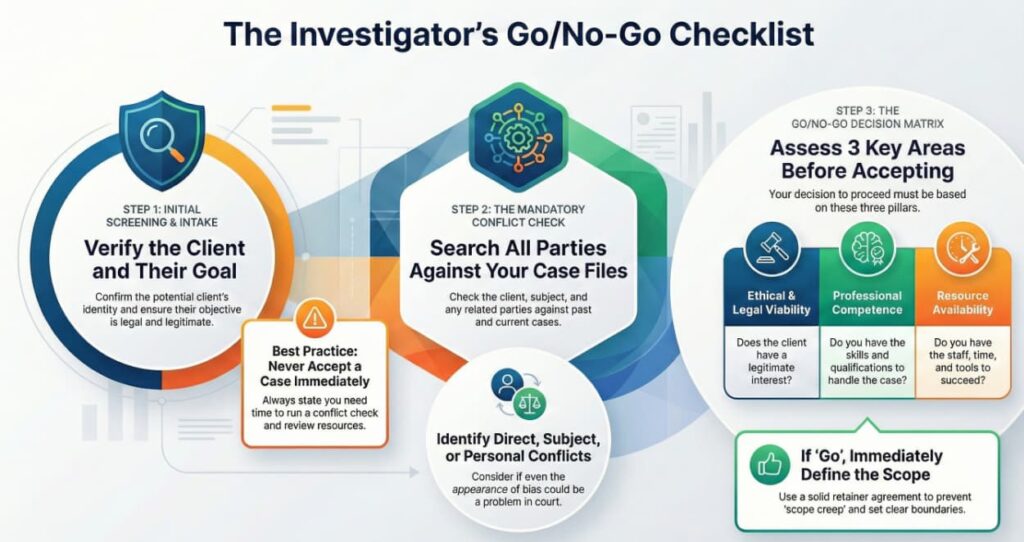
1. The Case Intake Process
The investigation begins the moment the phone rings or the email arrives. This initial phase is not just about listening—it is about screening.
Key Steps in Intake:
- Identity Verification: Verify who the potential client is. (Is this a legitimate corporate counsel, or a stalker posing as a business owner?)
- Initial Facts: Gather the “Who, What, When, Where, Why.”
- Client Goal: What does the client actually want?
- Legitimate: “We want to know if our employee is selling trade secrets.”
- Illegitimate: “We want you to hack their email to find out.”
PCI Best Practice: Never accept a case immediately during the first call. Always state: “Let me run a conflict check and review our resources, and I will get back to you.” This buys you time to vet the client.
2. The Conflict of Interest (COI) Check
Before you hear confidential details, you must ensure you aren’t already working for the “other side.” This is a mandatory step in the ASIS standard.
How to Run a COI Check:
- Search Your Database: Check the names of the Potential Client, the Subject(s), and any Related Parties (subsidiaries, partners) against your past and current case files.
- Identify the Conflict Types:
- Direct Conflict: You are currently investigating the Potential Client for another case.
- Subject Conflict: You previously represented the Subject in a different matter.
- Personal Conflict: The Subject is your cousin, neighbor, or former business partner.
- The “appearance” of Conflict: Even if no direct conflict exists, ask yourself: “If this case goes to court, could an opposing lawyer claim I was biased?”
3. The “Go / No-Go” Decision Matrix
Once the COI check is clear, you must decide if you should take the case. ASIS requires you to assess three specific areas:
A. Ethical & Legal Viability
- Is the objective legal?
- Does the client have a legitimate interest? (e.g., An employer has a legitimate interest in investigating theft; a jealous ex-boyfriend does not have a legitimate interest in surveillance).
B. Professional Competence
- The Rule: Do not accept a case you are not qualified to handle.
- Example: If you are a physical surveillance expert, do not accept a complex “Cyber-Forensics” case unless you have a qualified subcontractor lined up. Accepting a case beyond your skill set is an ethics violation.
C. Resource Availability
- Do you have the staff?
- Is the timeline realistic?
- Example: A client wants a missing person found in 24 hours, but you are a solo operator with two other active cases. Taking this case would be negligent.
4. Defining the Scope (Stopping Scope Creep)
If you decide to take the case, you must limit the scope before you start.
- Scope: The specific boundaries of the work.
- Correct: “Investigator will conduct 3 days of surveillance to observe the Subject’s physical activity level.”
- Incorrect (Too Broad): “Investigator will find out everything about the Subject.”
- Scope Creep: When a client slowly adds more tasks without adding more budget or time. “While you’re there, can you also check on his wife?”
- The Fix: A solid Retainer Agreement that strictly defines the objective.
Lesson Summary
- Intake is a vetting process, not just a sales call. Verify the client’s identity and intent.
- COI Checks are mandatory. Protect yourself from ethical violations by checking names before accepting confidential info.
- Competence: Only sell what you can truly deliver.
- Legitimate Interest: Ensure the client has a legal reason to request the investigation.
Knowledge Check
(Self-Assessment)
- Why is it important to verify the identity of a potential client during intake?
- If you are a fraud examiner but a client asks you to perform a complex deep-water recovery of evidence, what should you do according to ASIS ethics?
- What is “Scope Creep”?