Back to: ASIS PCI Study Guide
Lesson 1: Introduction to the ASIS PCI Designation & Exam Structure
Lesson Objective: By the end of this lesson, you will understand the value of the Professional Certified Investigator (PCI) board certification, the specific eligibility requirements, the structure of the exam, and the authoritative resources required to pass.
1. What is the PCI?
The Professional Certified Investigator (PCI) is a technical certification awarded by ASIS International. Unlike the CPP (Certified Protection Professional), which covers broad security management, or the PSP (Physical Security Professional), which focuses on hardware and systems, the PCI is hyper-focused on the investigative process.
It validates an individual’s ability to:
- Collect and analyze evidence.
- Conduct interviews and interrogations.
- Manage case flow and strategy.
- Present findings in a legal or corporate setting.
Key Concept: The exam does not test “how things are done in your local police precinct.” It tests the ASIS Standard. You must answer questions based on ASIS reference materials, even if your personal experience differs.
2. Eligibility Requirements
Before investing time in study, candidates must ensure they meet the strict eligibility criteria. ASIS performs audits on applications.
- Work Experience: Five years of investigations experience (or three years if you hold a Master’s degree or higher).
- Case Management Requirement: At least two of those years must be in Case Management. This means you were not just “following orders” but were responsible for the planning, strategy, and oversight of the investigation.
- Clean Record: No criminal convictions that would reflect negatively on the profession.
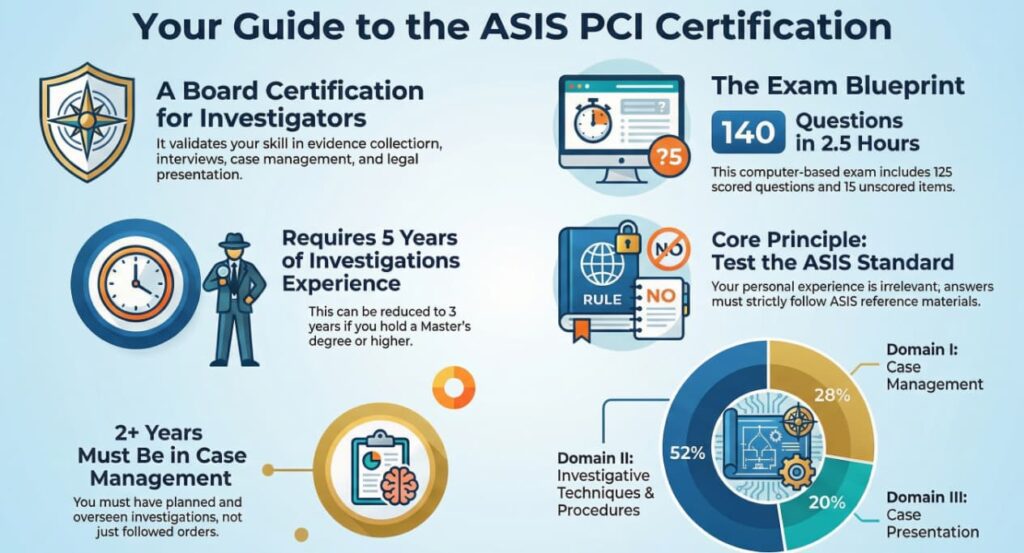
3. The Exam Structure
Understanding the weight of each section is critical for study planning. The exam focuses heavily on “boots on the ground” techniques.
Exam Logistics:
- Format: Computer-based testing (Proctored).
- Length: 140 questions total (125 scored items + 15 unscored “pre-test” items).
- Time Limit: 2.5 hours.
The Three Domains: The exam is broken down into three specific domains. Note that Domain II is more than half the exam.
- Domain I: Case Management (28%)
- Covers: Analyzing the case flow, internal and external resources, and ethical considerations.
- Domain II: Investigative Techniques & Procedures (52%)
- Covers: Surveillance, interviews, interrogation, evidence collection, and research.
- Domain III: Case Presentation (20%)
- Covers: Report writing, testimony, and post-case adjudication.
4. Required Reference Materials
You cannot pass this exam using general knowledge alone. The questions are drawn directly from specific texts.
- The Protection of Assets (POA): Investigations: This is the “Bible” for the exam. It covers the methodology, legal concepts, and specific techniques (surveillance, fraud, etc.).
- ASIS Professional Certified Investigator (PCI) Study Guide: Provides the framework and practice questions.
- ASIS Standards: specifically the Investigations standard.
5. Strategy for Success
- Think Like a Manager: While Domain II is technical, many questions ask what the best first step is. Usually, the answer involves planning or safety, not immediately kicking down a door.
- Terminology Matters: Distinguish between terms like interview vs. interrogation or covert vs. undercover. ASIS uses these terms very specifically.
- Global Perspective: ASIS is international. Avoid assuming U.S.-specific laws apply unless the question specifies a jurisdiction (though U.S. common law principles are heavily featured).
Lesson Summary
The PCI is a specialized verification of your ability to manage and execute an investigation from start (case acceptance) to finish (testimony). To pass, you must master the three domains, with a primary focus on Domain II (Techniques), and adhere strictly to the ASIS Body of Knowledge.
Knowledge Check
(Self-Assessment)
- Which Domain carries the most weight on the exam?
- Does the PCI exam test your local laws or ASIS standards?
- How many years of specifically Case Management experience are required?