Back to: ASIS PCI Study Guide
Lesson 2: The ASIS Code of Professional Responsibility
Lesson Objective: By the end of this lesson, you will be able to interpret the ASIS Code of Professional Responsibility and apply its ethical canons to real-world investigative scenarios. You will understand why ethical compliance is a “pass/fail” criterion in both the exam and the profession.
1. Why Ethics Matter on the Exam
In the PCI exam, you will encounter scenario-based questions where two answers seem technically correct. However, one answer will usually be superior because it aligns more closely with ethical mandates.
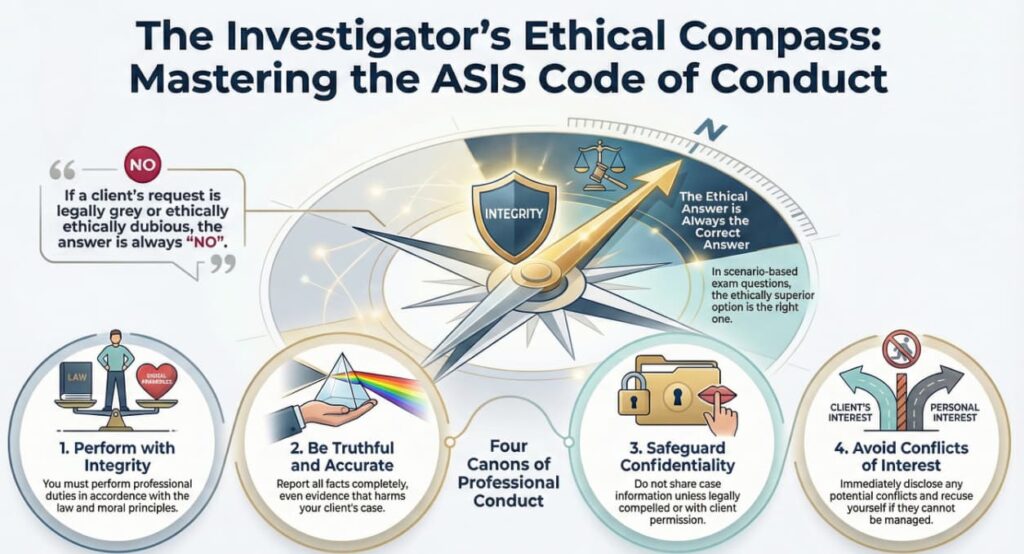
The Golden Rule of the PCI Exam: If a client asks you to do something that is technically possible but legally gray or ethically dubious, the answer is always NO.
2. The ASIS Code of Professional Responsibility
As an ASIS-certified professional, you are bound by a specific code. Violation of this code can result in the revocation of your certification. While there are several articles, the following are most critical for investigators:
I. Performance with Integrity
- The Rule: You must perform professional duties in accordance with the law and the highest moral principles.
- Investigative Application: You cannot break the law to solve a case. If a client suggests “pretexting” to get bank records (which is illegal in many jurisdictions under laws like the Gramm-Leach-Bliley Act in the US), you must refuse.
II. Truthfulness and Accuracy
- The Rule: You must be truthful, accurate, and complete in reporting.
- Investigative Application: You cannot omit exculpatory evidence (evidence that clears a subject) just because it hurts your client’s case. You are a finder of fact, not a hired gun to prove a specific narrative.
III. Confidentiality
- The Rule: You must protect the confidentiality of information acquired during your duties.
- Investigative Application: This is the most common pitfall. You cannot share case details with your spouse, former colleagues, or the media, unless legally compelled or with client permission.
IV. Conflicts of Interest
- The Rule: You must avoid conflicts of interest or the appearance of conflicts.
- Investigative Application: If you are asked to investigate a company where your sibling is the CFO, you must disclose this immediately. If the conflict cannot be managed, you must recuse yourself.
3. The Ethical Decision-Making Model
When faced with a dilemma during an investigation, ASIS encourages a structured approach.
- Identify the Problem: Is this a legal issue? An ethical one? A safety one?
- Consult the Code: Does the ASIS Code specifically address this (e.g., confidentiality)?
- Identify the Stakeholders: Client, Subject, Public, Law Enforcement, Yourself.
- Assess Options:
- Option A: Do what the client asks (Risk: Unethical/Illegal).
- Option B: Refuse and explain why (Risk: Lose client, preserve integrity).
- Option C: Propose a legal alternative (Best Practice).
4. Common Exam Scenarios
You will likely see questions similar to these concepts:
- Scenario: A client wants you to put a GPS tracker on an employee’s personal car without their knowledge.
- Analysis: In many jurisdictions, this is illegal (trespass/stalking). Even if legal in a specific spot, it is high liability.
- PCI Answer: Refuse the request, explain the liability/illegality, and suggest legal surveillance methods instead.
- Scenario: You discover your client is using your investigative reports to commit a crime (e.g., stalking an ex-partner).
- Analysis: Your duty to the law supersedes your duty to the client.
- PCI Answer: Cease the investigation immediately and consult legal counsel regarding reporting obligations.
Lesson Summary
The ASIS PCI designation assumes you act as a “Fact Finder,” not a “Case Winner.” Your primary tools are Integrity, Legality, and Confidentiality. If an investigative technique requires you to compromise any of these, it is not an approved ASIS technique.
Knowledge Check
(Self-Assessment)
- If a client demands you omit a piece of evidence that makes them look bad, what Article of the Code prevents you from doing so? (Hint: Truthfulness).
- True or False: It is acceptable to share “anonymized” war stories about active cases at a bar with friends.
- What is the first step when you identify a potential conflict of interest?