Back to: ASIS PSP – Preparation Course
What is CPTED?
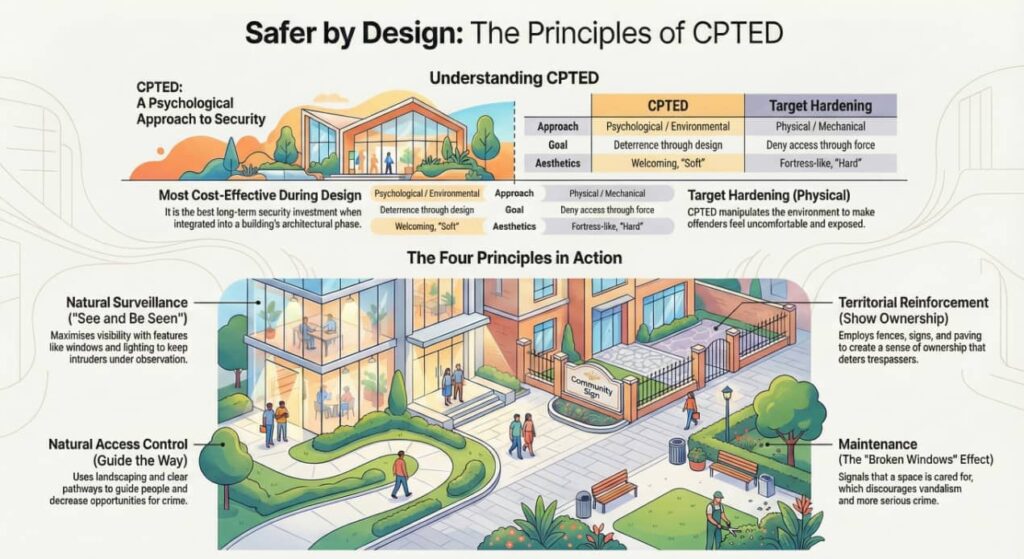
CPTED (pronounced sep-ted) is based on the premise that the proper design and effective use of the built environment can lead to a reduction in the fear and incidence of crime.
Unlike “Hard” security (locks, cameras, guards), CPTED is psychological. It manipulates the environment to:
- Make the offender feel exposed and uncomfortable.
- Make the legitimate user feel safe and entitled to the space.
Exam Tip: If a question asks for the “most cost-effective” long-term security measure during the architectural design phase, the answer is usually CPTED.
2. The Three Core Principles
You must memorize these three pillars. Exam scenarios will describe a design feature (e.g., a window placement) and ask which principle it represents.
A. Natural Surveillance (“See and Be Seen”)
The placement of physical features, activities, and people in a way that maximizes visibility. The goal is to keep intruders under observation.
- Mechanism: Criminals do not want to be seen.
- Examples:
- Placing windows overlooking sidewalks and parking lots.
- Using open-style fencing (chain link or wrought iron) instead of solid walls.
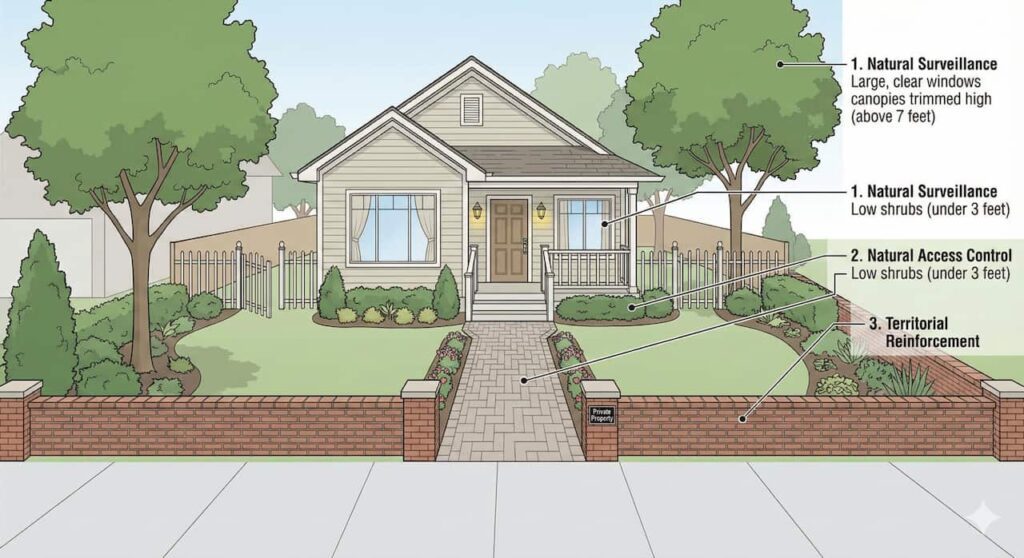
- Trimming hedges to 3 feet (maximum) and tree canopies to 7 feet (minimum) to maintain a clear visual corridor.
- Lighting: Ensures visibility at night.
B. Natural Access Control
The use of building elements to guide people into and out of a space, decreasing opportunities for crime.
- Mechanism: Denying access to targets and creating a perception of risk for offenders.
- Examples:
- Clearly marked pathways and sidewalks.
- Thorny bushes (e.g., holly, barberry) under windows to discourage climbing.
- Using distinct landscaping or flower beds to separate public from private areas.
- Note: This differs from “Mechanical” access control (locks/bars). It guides rather than physically stops.
C. Territorial Reinforcement
The use of physical attributes to express ownership, such as fences, pavement treatments, art, signage, and landscaping.
- Mechanism: Creating a sense of “This belongs to someone.” Legitimate users feel protective; intruders feel like they are trespassing.
- Examples:
- Changing the pavement from concrete (public sidewalk) to brick (private walkway).
- Signage (“Private Property,” “Welcome to XYZ Corp”).
- Well-maintained gardens and clear property lines.
3. The Fourth Principle: Maintenance & Management
Often called the “Broken Windows Theory.”
- Concept: If a broken window is left unrepaired, it signals that “no one cares” about the property. This invites vandalism, squatting, and more serious crime.
- Application: Immediate graffiti removal, fixing burnt-out lights, and keeping landscaping trimmed are active security measures.
4. The “3-D” Approach
To assess a space for CPTED compliance, ASIS uses the 3-D methodology. You evaluate a space by asking these three questions:
- Designation: What is the designated purpose of this space?
- Is it for walking? Sitting? Parking?
- Definition: How is the space defined?
- Are there borders? Do we know where the public space ends and private space begins?
- Design: Does the physical design support the intended function?
- If it’s a walkway, is it lit? If it’s a private patio, is it shielded?
Scenario: A park bench is placed in a dark, unmonitored corner (Design) but is intended for families (Designation).
- Result: The Design contradicts the Designation. Drug dealers use it instead.
- Fix: Move the bench to a well-lit area (Design supports Designation).
5. CPTED vs. Target Hardening
The exam may ask you to differentiate between these two approaches.
| Feature | CPTED | Target Hardening |
| Approach | Psychological / Environmental | Physical / Mechanical |
| Goal | Deterrence through design | Deny access through force |
| Examples | Landscaping, Lighting, Windows | Deadbolts, Barbed Wire, Bollards |
| Aesthetics | Welcoming, “Soft” | Fortress-like, “Hard” |
Real world tip: The “Winter” Surprise: CPTED landscaping looks great in summer. In winter, when the leaves fall off the bushes, your “natural barrier” disappears. Always design for the “worst season” (or the darkest time of year).