Back to: ASIS PSP – Preparation Course
0
Objective: By the end of this lesson, you will be able to apply the “Triple Constraint” to decision-making, identify the Critical Path in a schedule, and distinguish between the five phases of the formal Project Management Lifecycle (PMI standard).
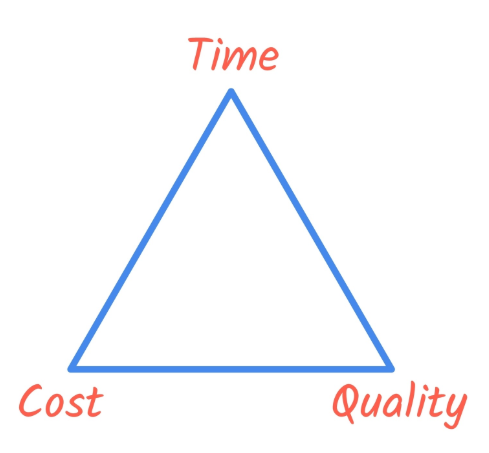
1. The Triple Constraint (The Iron Triangle)
Every project is constrained by three competitive factors. You cannot change one without affecting the others. This is the fundamental rule of Project Management.
- Scope: What work will be done? (The Deliverables).
- Time: How long will it take? ( The Schedule).
- Cost: What is the budget? (The Resources).
- Center: Quality sits in the middle. If you shrink cost and time but keep scope the same, Quality suffers.
2. The Project Lifecycle (The 5 Phases)
The PSP exam follows the standard PMI (Project Management Institute) model. You must know what activities happen in which phase.
Phase 1: Initiation
- Goal: Define the project at a high level and get approval to start.
- Key Output: Project Charter. This is the document that formally authorizes the project and gives the Project Manager (PM) the authority to use resources.
- Activity: Identifying stakeholders (Who cares about this project?).
Phase 2: Planning (The Most Critical Phase)
- Goal: Establish the total scope, define objectives, and refine the course of action.
- Key Output: Project Management Plan (WBS, Schedule, Budget).
- Work Breakdown Structure (WBS): Decomposing the big project into small, manageable chunks called “Work Packages.”
- Rule: You cannot manage what you cannot define. The WBS defines the work.
Phase 3: Execution
- Goal: Complete the work defined in the plan.
- Activity: Coordination of people and resources. This is where the cables are pulled and cameras mounted.
- Spend: The vast majority of the budget is spent here.
Phase 4: Monitoring and Controlling
- Goal: Track, review, and regulate the progress and performance. Identify variances from the plan.
- Activity: Change Control. If a change is requested (e.g., “Add 5 more cameras”), it must go through a formal Change Order process to assess its impact on Time and Cost.
- Note: This phase happens simultaneously with Execution.
Phase 5: Closing
- Goal: Formalize acceptance of the project.
- Activity:
- Punch List: A list of minor tasks that must be fixed before final payment.
- As-Built Drawings: Updated drawings showing exactly how the system was installed.
- Lessons Learned: Documenting what went right/wrong for future projects.
3. Scheduling Tools
How do we track time?
A. Gantt Charts
- Visual: Bar charts showing tasks against a calendar.
- Use: Good for showing status and duration to management. “Are we on schedule?”
- Weakness: Does not clearly show dependencies (how Task A affects Task B).
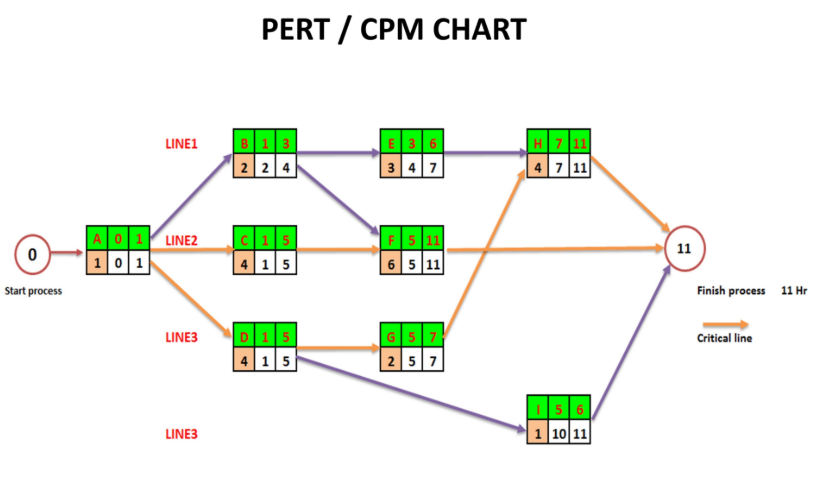
B. PERT / CPM (Critical Path Method)
- Visual: A network diagram of boxes and arrows.
- Key Concept: The Critical Path.
- Definition: The sequence of tasks that represents the longest path through the project.
- Significance: It determines the shortest possible time to complete the project.
- Rule: If a task on the Critical Path is delayed by 1 day, the entire project is delayed by 1 day.
- Slack/Float: Tasks not on the critical path have “float” (they can be delayed slightly without hurting the end date).
4. Scope Creep
- Definition: The uncontrolled expansion of project scope without adjustments to time, cost, or resources.
- Cause: “Gold Plating” (adding features the customer didn’t ask for) or vague initial requirements.
- The Fix: A rigid Change Control Board (CCB) process. No changes are accepted unless the impact on budget and schedule is approved in writing.
5. Stakeholder Management
A project fails if the stakeholders are unhappy, even if the cameras work perfectly.
- Identification: Do this early. Stakeholders include the Client, the End Users (Guards), the IT Department (who own the network), and Facilities (who own the walls).
- Communication: different stakeholders need different info.
- CEO: Needs high-level budget/timeline status.
- IT Director: Needs bandwidth calculations and IP addressing schemes.
- Guard Force: Needs training on how to use the joystick.