Back to: ASIS PSP – Preparation Course
Objective: By the end of this lesson, you will be able to specify appropriate fencing types based on risk, understand the mechanical operation of gates, and select vehicle barriers (bollards) using ASTM crash-rating standards.
1. The Perimeter Function
The perimeter is your first physical layer of defense. It serves three functions:
- Define the boundary: “This is where private property begins.”
- Deter: Make access difficult or psychologically discouraging.
- Delay: Slow down an intruder long enough for detection and response.
Crucial Concept: A fence is a delay mechanism, not a denial mechanism. Given enough time and tools, any fence can be breached.
2. Fencing Standards (Highly Testable)
The Chain-Link Fence is the industry workhorse. You must know the ASIS/ASTM specifications for a “Security Grade” fence.
A. Chain-Link Specifications
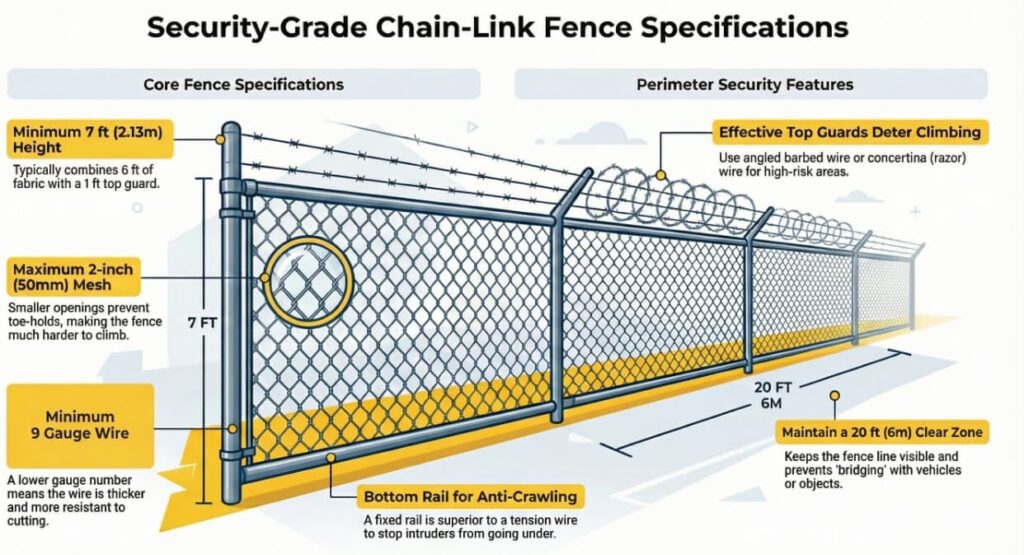
- Height: Minimum 7 feet (2.13 meters) overall.
- Typically composed of 6 feet of fabric + 1 foot of top guard.
- Mesh Size: Maximum 2 inches (50mm).
- Why? Smaller mesh makes it harder to get a toe-hold for climbing. High-security mesh is often 3/8 inch (Anti-climb/Anti-cut).
- Gauge: Minimum 9 gauge (Standard heavy duty) or 11 gauge (Lighter, residential). Lower number = Thicker wire.
- Anchoring: Posts must be set in concrete.
- Bottom Rail: Preferred over a tension wire to prevent crawling under the fence.
B. Top Guards
- Barbed Wire: Standard is 3 strands angled outward at 45 degrees.
- Note: Angling it outward makes it harder to climb in. Angling it inward keeps people in (prisons). V-shaped (both ways) is maximum security.
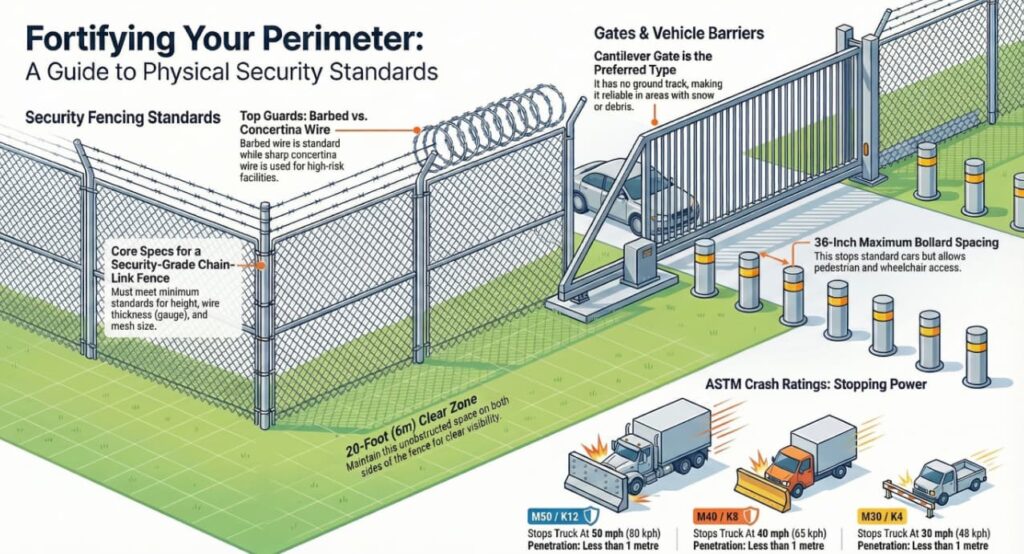
- Concertina Wire (Razor Wire): A coil of sharp blades. Much more dangerous and intimidating. Used for high-risk facilities.
C. Clear Zones
You must maintain a clear zone on both sides of the fence to ensure the view is not blocked and to prevent “bridging” (using a tree or truck to jump the fence).
- Standard: 20 feet (6 meters) clear on both the inside and outside.
3. Gates and Entry Points
The gate is the “weakest link” in the perimeter because it is a moving part designed to open.
A. Gate Types
- Swing Gate: Hinged on one side.
- Pros: Simple, cheap.
- Cons: Requires a large arc of space to open. Slow operation. susceptible to wind.
- Slide Gate: Slides on wheels along a track.
- Pros: No swing arc needed. Secure.
- Cons: The track can get clogged with snow/ice/debris.
- Cantilever Gate: Slides sideways but hangs in the air (counter-balanced). No track on the ground.
- Pros: Best for snow/dirt areas. Reliable.
- Cons: Requires a long “tail” (counterbalance section) for storage when open.
- Best Practice: This is the preferred gate for most industrial security applications.
4. Vehicle Barriers (Anti-Ram)
If the threat is a vehicle bomb (VBIED) or a “crash-and-grab,” a fence is useless. You need barriers.
A. Active vs. Passive
- Passive: Fixed items (Concrete planters, fixed bollards, walls).
- Active: Moving items (Retractable bollards, hydraulic wedges, drop-arms).
B. Crash Ratings (ASTM F2656)
You may see older “K-Ratings” (DOS) or newer “M-Ratings” (ASTM). They measure how well a barrier stops a 15,000 lb (6,800 kg) truck (standard medium-duty truck).
- K12 / M50: Stops a truck at 50 mph (80 kph). Penetration < 1 meter.
- K8 / M40: Stops a truck at 40 mph (65 kph).
- K4 / M30: Stops a truck at 30 mph (48 kph).
Exam Tip: If the question asks for the highest standard rating for a high-risk government facility, look for K12 or M50.
C. Bollard Layout
- Spacing: Maximum 36 inches (3 feet) between bollards.
- Why? This stops a passenger car but allows pedestrians and wheelchairs (ADA compliance) to pass freely.
5. Other Perimeter Elements
- Signage: Must be posted at intervals (e.g., every 50 feet or 100 feet) to meet legal requirements for “Trespassing.” It removes the excuse “I didn’t know I wasn’t allowed here.”
- Jersey Barriers: Modular concrete blocks. Good for temporary security but ugly.
- Buried Sensors: (Covered more in Electronic Systems) but often installed in the clear zone.
Real world tip: The “Winter” Surprise: CPTED landscaping looks great in summer. In winter, when the leaves fall off the bushes, your “natural barrier” disappears. Always design for the “worst season” (or the darkest time of year).