Back to: ASIS PSP – Preparation Course
Objective: By the end of this lesson, you will be able to select the correct transmission media (Fiber vs. Copper) based on distance and environmental interference, calculate power requirements using Ohm’s Law, and apply the correct Power over Ethernet (PoE) standards to devices.
1. Transmission Media: The Backbone
Security devices are useless if the signal cannot reach the controller. The choice of cable is dictated by Bandwidth, Distance, and Environment.
A. Twisted Pair (Copper)
The standard for modern IP security.
- UTP (Unshielded Twisted Pair): Common Ethernet cable (Cat5e, Cat6).
- Pros: Cheap, easy to install.
- Cons: Vulnerable to EMI (Electromagnetic Interference).
- STP (Shielded Twisted Pair): Has a foil shield.
- Use Case: Industrial factories, elevator shafts, or running near fluorescent lights (High EMI areas).
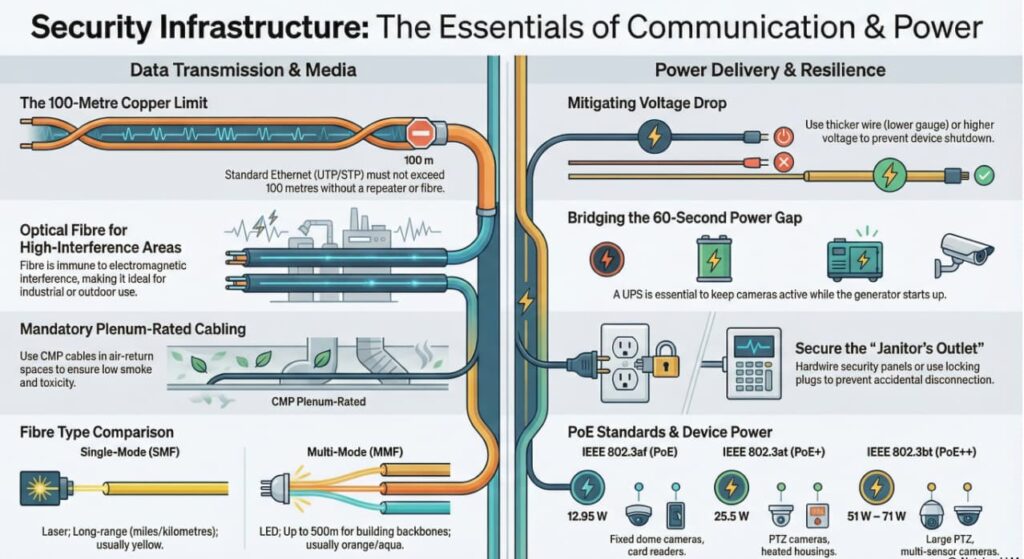
- The Golden Rule: The maximum distance for standard Ethernet is 100 meters (328 feet). Beyond this, you need a repeater or fiber.
B. Coaxial Cable (The Legacy)
- Type: RG-59 or RG-6.
- Use Case: Old analog CCTV cameras.
- Characteristics: Heavy shielding, good distance (up to 1,000 ft for video), but limited bandwidth.
- Transition: Many sites use “Ethernet over Coax” (EoC) converters to reuse old coax for new IP cameras.
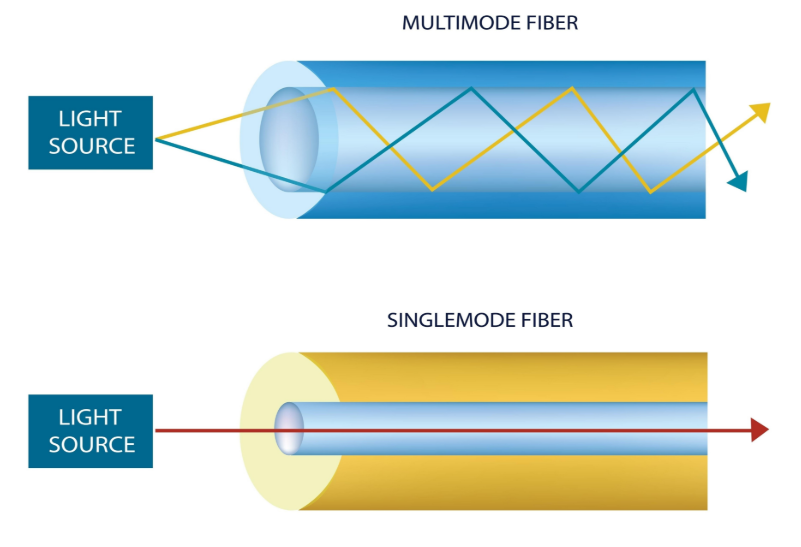
C. Fiber Optics (The Long Haul)
Uses light pulses instead of electricity.
- Key Advantage: Completely immune to EMI/RFI (Lightning, power surges, magnetic fields). Perfect for outdoor/perimeter use.
| Feature | Single-Mode Fiber (SMF) | Multi-Mode Fiber (MMF) |
| Core Size | Tiny (8-10 microns). | Larger (50 or 62.5 microns). |
| Light Source | Laser. | LED. |
| Distance | Miles/Kilometers (Long range). | Up to ~500m (Campus/Building backbone). |
| Cost | Cable is cheap; Electronics are expensive. | Cable is pricey; Electronics are cheaper. |
| Color Code | Usually Yellow. | Usually Orange or Aqua. |
2. Wireless Transmission
When you cannot trench or run cable, you use wireless.
A. Microwave / RF
- Line of Sight (LOS): The transmitter must see the receiver.
- Fresnel Zone: It is not enough to just see the other side; the “football-shaped” area of air around the straight line must be clear of obstacles (trees, trucks).
- Rule: If the Fresnel zone is blocked by more than 40%, the signal degrades.
B. WLAN (Wi-Fi)
- Security: Never use WEP (broken). Use WPA2 or WPA3.
- Jamming: Wireless is susceptible to denial-of-service attacks by jamming the frequency.
3. Power Systems Fundamentals
A PSP must ensure the system doesn’t turn off.
A. Basic Electrical Concepts (Ohm’s Law)
You need a basic grasp of the relationship between Voltage (V), Current (I, measured in Amps), and Resistance (R).
V = I x R
- Power Formula: Watts (P) is what you “pay for” (the load). P = V x I
- Example: A camera needs 12 Watts at 12 Volts. How many Amps?
- 12W = 12V x I
- I = 1 Amp.
B. Voltage Drop
Electricity loses pressure (Voltage) as it travels down a wire due to resistance.
- The Problem: You send 12V from the power supply. After 500 feet of thin wire, only 10V arrives at the camera. The camera shuts down.
- The Fix:
- Use thicker wire (Lower Gauge number = Thicker wire).
- Use a higher voltage (24V AC) and step it down at the device.
- Move the power supply closer.
4. Power over Ethernet (PoE)
This is the industry standard for IP cameras and card readers. Data and Power travel on the same Cat6 cable.
The Standards (IEEE)
You must match the PSE (Power Sourcing Equipment – the Switch) to the PD (Powered Device – the Camera).
| Standard | Name | Power at Source | Power at Device (PD) | Typical Devices |
| 802.3af | PoE | 15.4 W | 12.95 W | Fixed dome cameras, Card readers. |
| 802.3at | PoE+ | 30 W | 25.5 W | PTZ cameras with motors, Heated housings. |
| 802.3bt | PoE++ | 60W – 100W | 51W – 71W | Large PTZ, Multi-sensor cameras, Access Control Panels. |
5. Backup Power (Resiliency)
When the grid fails, the security system must remain active.
A. UPS (Uninterruptible Power Supply)
- Function: Battery backup that cleans (“conditions”) the power and provides instant power during an outage.
- Runtime: Usually short (15-30 minutes). Designed to bridge the gap until the generator starts or to allow a safe server shutdown.
B. Generators
- Function: Long-term power (Diesel/Gas).
- Startup Time: Takes 10 to 60 seconds to spin up.
- The “Gap”: You must have a UPS to keep the cameras alive during those 60 seconds. If a camera loses power, it reboots (which can take 2-5 minutes). You are blind for 5 minutes without a UPS.
6. Fire Safety in Cabling (Plenum Rating)
Building codes dictate what cable jacket you can use.
- Plenum Space: The space above a drop ceiling used for air circulation (HVAC).
- Plenum Rated Cable (CMP): Burns slowly and emits low smoke/low toxicity.
- Requirement: You MUST use Plenum cable if running wires in a plenum air return space.
- Riser Rated Cable (CMR): Used for vertical runs between floors. Cannot be used in plenum spaces.
Real world tip: The “Janitor’s Outlet”: Never plug your security panel or server into a standard wall outlet in a hallway. A janitor will unplug it to vacuum the floor.
- Tip: Hardwire the power or use a locking plug/receptacle. Label it “DO NOT UNPLUG – SECURITY.”