Back to: ASIS PSP – Preparation Course
Objective: By the end of this lesson, you will be able to define the four elements of negligence, explain the legal concept of “foreseeability,” and apply the “Life Safety First” hierarchy to resolve conflicts between security and building codes (Fire/ADA).
1. The Hierarchy of Compliance
Before you design a single barrier, you must understand the hierarchy of rules. If a security requirement conflicts with a code, the code wins.
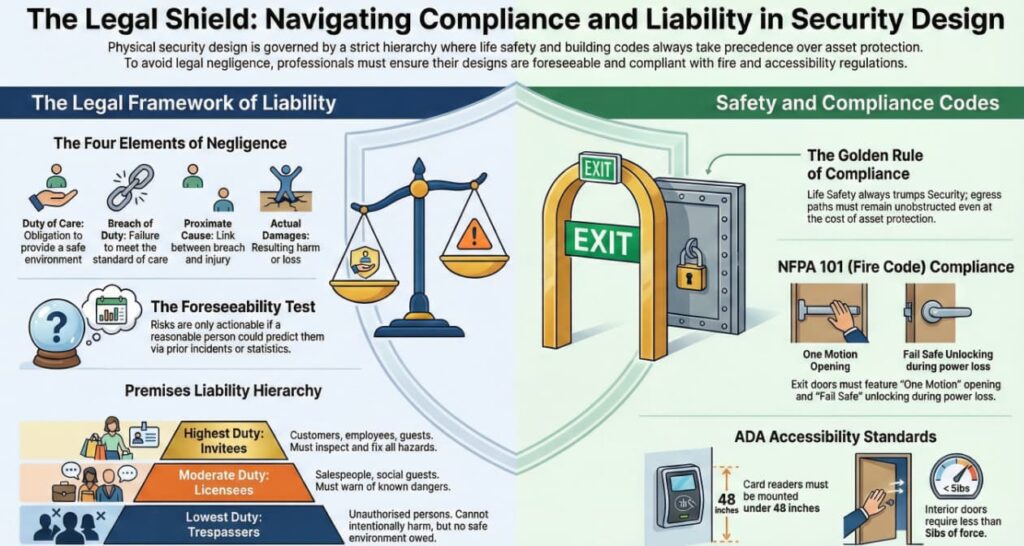
The Golden Rule: Life Safety always trumps Security.
- Scenario: You want to lock a door to prevent theft. The Fire Marshal wants it unlocked to allow escape.
- Result: The door must allow free egress. You must find another way to secure it (e.g., delayed egress hardware, alarms, cameras), but you cannot trap people inside.
2. Negligence and Liability
This is the most heavily tested legal concept. As a PSP, if you design a system that fails and someone gets hurt, you (and the organization) can be sued for Negligence.
The Four Elements of Negligence
To be found liable for negligence, a plaintiff must prove all four of these elements existed:
- Duty of Care: Did you have a legal obligation to protect the person? (e.g., A store owner has a duty to customers).
- Breach of Duty: Did you fail to meet the “Standard of Care”? (e.g., You knew the lock was broken and didn’t fix it).
- Proximate Cause: Did your breach directly cause the injury? (e.g., The thief entered through the broken lock to attack the victim).
- Damages: Did the victim suffer actual loss (injury, financial, psychological)?
Foreseeability (The “Crystal Ball” Test)
This is a subset of “Duty.” You are only required to protect against risks that are Foreseeable.
- The Test: Would a “Reasonable Person” have predicted this crime?
- Evidence of Foreseeability:
- Prior Incidents: Has this happened here before?
- Crime Statistics: Is the neighborhood known for this type of crime?
- Recency/Frequency: Did similar crimes happen recently nearby?
Exam Tip: If a question asks if a facility is liable for a random, unprecedented meteor strike, the answer is usually No (Not foreseeable). If it asks about a car theft in a lot where 5 cars were stolen last month, the answer is Yes (Foreseeable).
Real world tip: The “CYA” Email: If a client insists on violating a code (e.g., locking a fire exit), you must document your objection. Send an email: “Per our discussion, I advised against X due to NFPA 101 code. You have chosen to proceed with X despite this warning.” Save that email forever. It is your legal shield.
3. Premises Liability Status
The level of protection you owe a person depends on why they are on your property.
| Status | Definition | Duty Owed |
| Invitee | Customers, employees, guests. (Invited for business). | Highest Duty: You must inspect for hazards and fix them. |
| Licensee | Salespeople, police, social guests. (Allowed but not strictly “invited” for profit). | Moderate Duty: You must warn them of known dangers. |
| Trespasser | Unauthorized persons. | Lowest Duty: You cannot intentionally harm them (no booby traps), but you don’t owe them a safe environment. |
Note: The “Attractive Nuisance” doctrine is an exception for children (e.g., an unfenced swimming pool).
4. Codes and Regulations (The “Design Killers”)
You must know how these specific codes impact physical security hardware.
A. Fire Codes (NFPA 101 – Life Safety Code)
- Means of Egress: The path to exit must be continuous and unobstructed.
- The “One Motion” Rule: You must be able to open an exit door with one hand and one motion (e.g., no twisting a deadbolt and turning a handle).
- Fail Safe: If power is cut (fire alarm triggers), magnetic locks (MagLocks) on fire doors must unlock automatically.
B. Americans with Disabilities Act (ADA)
- Door Force: Interior doors generally cannot require more than 5 lbs of force to open. (Heavy security closers often violate this).
- Clearance: Turnstiles and mantraps must have a wheelchair-accessible lane (minimum 32-36 inches wide).
- Height: Card readers and intercoms must be mounted at a height accessible to someone in a wheelchair (typically 48 inches max).
C. Privacy Laws
- Video Surveillance: Generally legal in public/work areas, but illegal in areas with a “Reasonable Expectation of Privacy” (Restrooms, locker rooms).
- Audio Recording: Much stricter than video.
- One-Party Consent: Only one person in the conversation needs to know it’s being recorded.
- Two-Party (All-Party) Consent: Everyone must know.
- Best Practice: Avoid audio recording unless absolutely necessary.