Objective: By the end of this lesson, you will be able to evaluate the security rating of door assemblies, distinguish between “safety glass” and “security glass,” and apply the correct electromechanical locking hardware (Fail Safe vs. Fail Secure) based on life safety codes.
1. The Door Assembly (The “System” Approach)
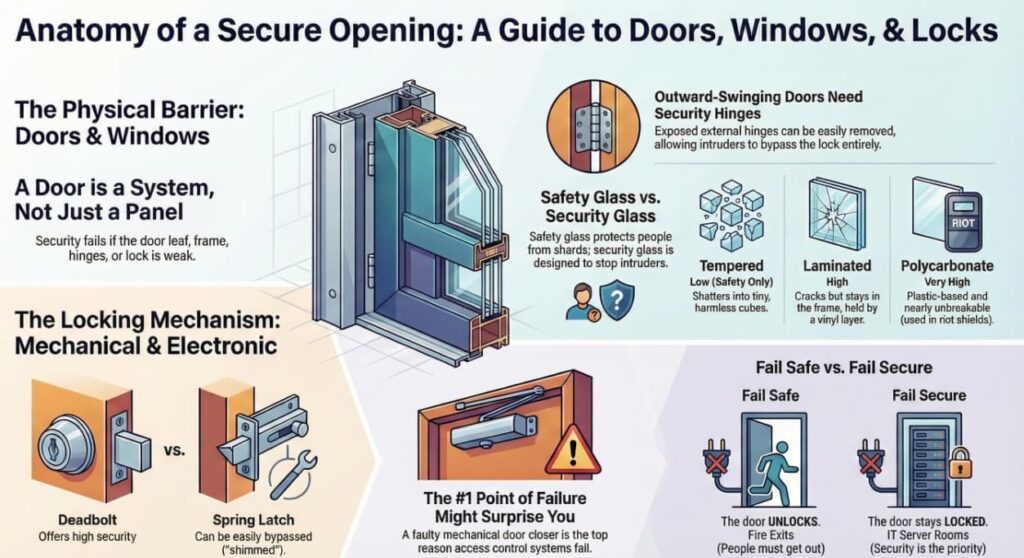
A common mistake is buying a high-security lock and putting it on a cheap door. The Door Assembly is a system composed of four parts. If any part fails, the security is breached.
The Door Leaf: The actual swinging panel.
Hollow Metal: The industry standard for exterior security. Internal steel ribs/stiffeners prevent buckling.
Solid Core Wood: Acceptable for interiors.
Hollow Core Wood: Residential only. Zero security value (can be punched through).
The Frame: Must be grouted (filled with concrete) or heavily reinforced. If the frame spreads, the latch disengages.
The Hinges:
Outward Opening Doors: Hinges are on the outside (attack side). You must use Security Hinges (with non-removable pins or studs) so an intruder cannot pop the pins and remove the door.
Inward Opening Doors: Hinges are protected inside. Easier to kick in (force is against the latch/strike, not the frame stop).
The Lock: (Covered below).
Exam Term:“Door Strike” – The metal plate on the frame that catches the bolt. This is often the first point of failure during a kick-in attack.
2. Windows and Glazing
Glass is usually the weakest point in a building’s shell. You must know the difference between glass designed to protect people from shards (Safety) and glass designed to stop intruders (Security).
Explodes into thousands of tiny, dull cubes (“Rock salt”).
Laminated
Two layers of glass with a vinyl (PVB) interlayer.
High
Cracks but stays in the frame. The vinyl holds it together.
Polycarbonate
Plastic (Acrylic/Lexan).
Very High
almost unbreakable. Used for riot shields.
B. Security Ratings (UL 752)
Bullet-Resistant (BR) Glass is heavy and expensive. It is usually a “sandwich” of glass and polycarbonate.
Level 1: Stops 9mm handgun.
Level 3: Stops .44 Magnum.
Level 4: Stops rifle fire (.30-06).
Note: There is no such thing as “Bullet Proof” glass, only “Bullet Resistant.” Eventually, it will fail.
3. Mechanical Locking Systems
The lock is the interface between the user and the door.
A. Lock Types
Spring Latch: The slanted bolt that clicks shut automatically.
Vulnerability: Can be “loided” (shimmed with a credit card). Low Security.
Deadbolt: A square bolt that must be manually thrown.
Security: extends deep into the frame (1 inch throw is standard). Cannot be shimmed. High Security.
Mortise Lock: The lock body is recessed inside the door edge. Very strong, very expensive.
Rim Lock: Mounted on the surface of the door (e.g., a crash bar or night latch).
B. Cylinders and Keying
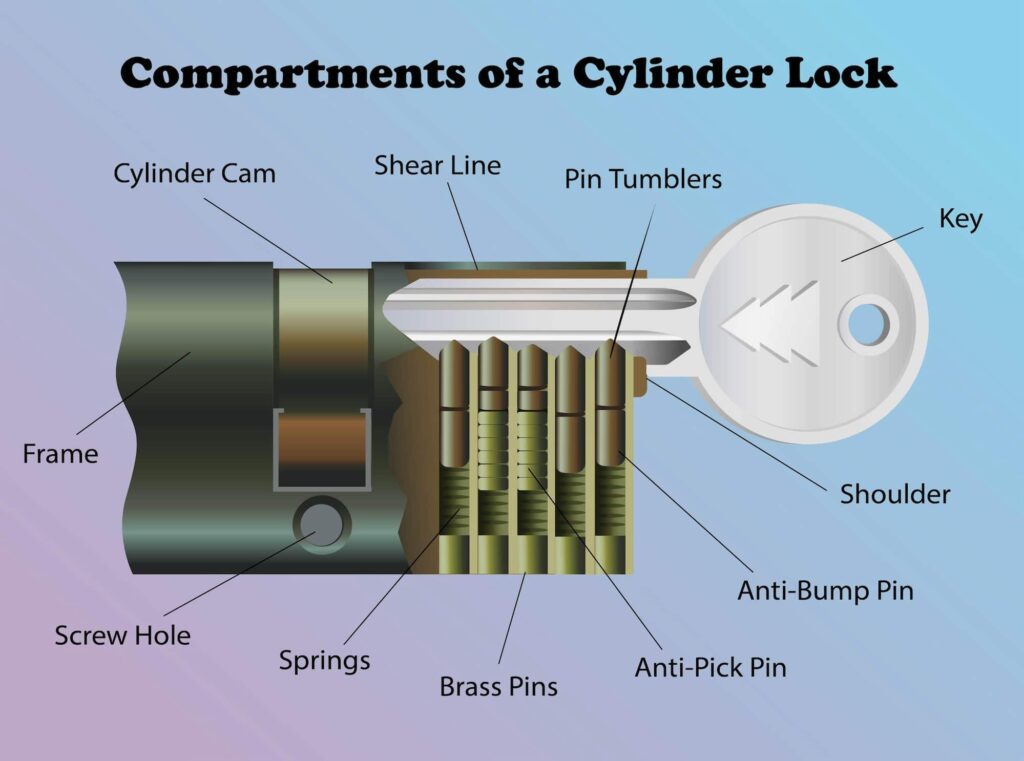
Pin Tumbler: The standard mechanism. A key lifts pins to the “Shear Line.”
Master Keying: A hierarchical system necessary for facility management.
Change Key: Opens one specific door (Employee).
Master Key: Opens a group of doors (Department Manager).
Grand Master Key: Opens all groups (Building Manager).
Great Grand Master Key: Opens everything (The “God Key”).
Risk: If a Master Key is lost, you must re-key every lock under that hierarchy.
4. Electromechanical Locking (Access Control)
This links the physical door to the electronic access control system.
A. Electric Strike
How it works: Replaces the standard door strike plate. When power is applied, a “keeper” releases, allowing the door latch to pass through without turning the handle.
Usage: Best for standard security doors.
B. Electromagnetic Lock (MagLock)
How it works: An electromagnet bonds a metal plate (armature) on the door to the frame.
Strength: Measured in holding force (e.g., 600 lbs, 1200 lbs).
Usage: Used on glass doors or perimeter exit doors.
C. Fail Safe vs. Fail Secure (CRITICAL EXAM CONCEPT)
You must apply this correctly based on Life Safety codes.
Mode
Power Status
Door Status
Use Case
Fail Safe
Power is ON to Lock. Power Cut = Unlock.
Unlocks
Fire Exits / MagLocks. People must escape if power dies.
Fail Secure
Power is OFF to Lock. Power Cut = Locked.
Stays Locked
IT Server Rooms / Vaults / Electric Strikes. Security is higher priority than exit (assuming manual handle works).
The Rule: MagLocks are almost alwaysFail Safe. They require power to lock. If the fire alarm cuts power, the door must open.
5. Exit Devices (Crash Bars)
Panic Hardware: Designed for mass egress. A bar extending at least half the width of the door.
Dogging: A feature that holds the crash bar permanently retracted (unlocked) during business hours so the door can be pulled open freely.
Security Risk: If “dogged down,” the door is unlocked. You cannot assume a door is secure just because it has a crash bar.
Real world tip: The “Door Closer” Reality: The #1 reason electronic access control fails isn’t the card reader or the software—it’s the mechanical door closer. If the hydraulic fluid leaks or the spring is too weak (due to air pressure/HVAC), the door won’t physically latch. If it doesn’t latch, the lock can’t lock.
Tip: Always check the closer first when troubleshooting a “door forced” alarm.