Back to: ASIS PSP – Preparation Course
Objective: By the end of this lesson, you will be able to differentiate between Passive and Active sensors, explain the concept of “Supervision” in alarm wiring, and select the appropriate sensor technology (PIR, Microwave, Dual-Tech) to minimize false alarms while maintaining detection probability.
1. The Core Metrics: Pd vs. NAR
Before selecting a sensor, you must understand the trade-off inherent in all IDS.
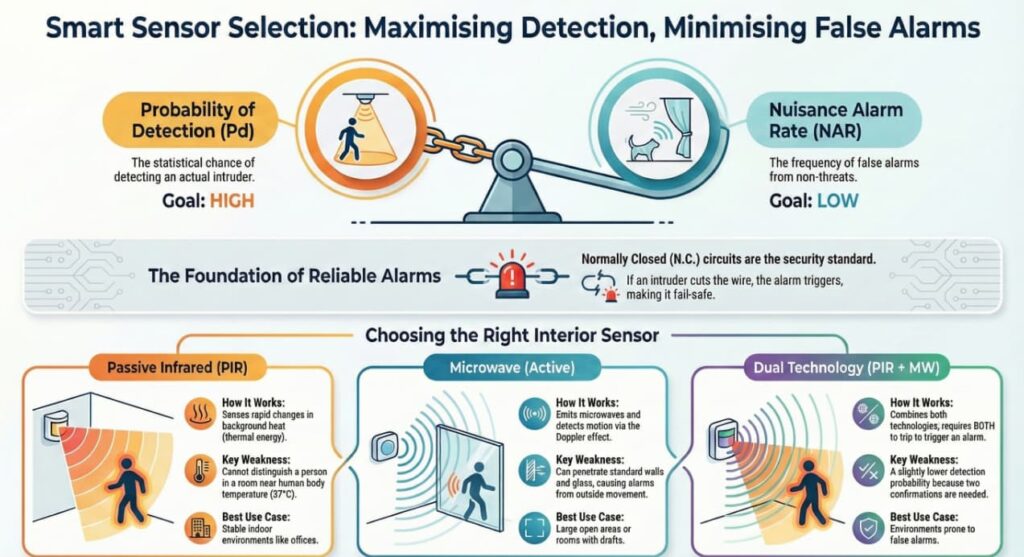
- Probability of Detection (Pd): The statistical chance that the sensor will detect an actual intruder. (We want this High).
- Nuisance Alarm Rate (NAR): The frequency of alarms caused by non-intrusion events (wind, animals, shadows). (We want this Low).
The Trade-off: Generally, as you increase sensitivity to get a higher Pd, you also increase the NAR. The goal of a PSP is to find the “sweet spot” where Pd is acceptable and NAR is manageable.
2. Alarm Circuitry Basics
You need to understand how the sensor talks to the panel.
A. Normally Closed (N.C.) vs. Normally Open (N.O.)
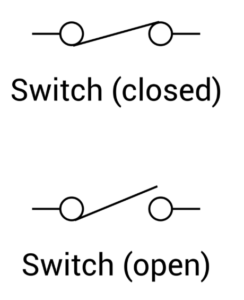
- Normally Open (N.O.): Like a doorbell. The circuit is broken; pushing the button completes it.
- Security Risk: If a thief cuts the wire, the circuit remains “open” forever. You will never get an alarm.
- Normally Closed (N.C.): The standard for security. The circuit is a closed loop where current flows constantly.
- Security Benefit: If the sensor trips (opens the switch) OR if a thief cuts the wire, the flow stops, and the alarm triggers. It is Fail Safe.
B. Supervision (End-of-Line Resistors)
Simple N.C. loops have a flaw: A thief can “short” the wires together before opening the door, bypassing the sensor.
- Supervision: We add a resistor (e.g., 2k Ohm) at the very end of the line (at the sensor).
- The Logic: The panel expects to see exactly 2k Ohms of resistance.
- 0 Ohms (Short): Trouble/Tamper.
- Infinite Ohms (Open/Cut): Alarm.
- 2k Ohms: Normal/Secure.
3. Interior Volumetric Sensors
These detect motion inside a room. The exam focuses on how they detect it and their specific weaknesses.
A. Passive Infrared (PIR)
- How it works: It does not emit energy (Passive). It looks for rapid changes in Thermal Energy (Infrared) moving across its field of view. It divides the room into “fingers” or zones.
- Best Use: General office, stable environments.
- Weaknesses:
- Temperature: If the room is 98°F (37°C), the sensor can’t distinguish a human body from the air.
- Masking: Can be defeated by covering the lens (spray paint/tape) if the sensor doesn’t have “Anti-masking” features.
- Glass: Cannot see through glass.
B. Microwave (Active)
- How it works: Emits microwave energy (Active) and measures the frequency shift of the reflected wave (Doppler Effect). If the wave comes back faster/slower, something is moving.
- Best Use: Large warehouses, areas with air drafts (which trigger PIRs).
- Weaknesses:
- Penetration: Microwaves can go through standard walls and glass. A truck driving outside the building can trigger a sensor inside.
- Fluorescent Lights: Can interfere with old microwave sensors.
C. Dual Technology (Dual-Tech)
- The Concept: Combines PIR and Microwave in one housing.
- AND Gate Logic:Both sensors must trip at the same time to trigger an alarm.
- Scenario: The AC turns on (PIR trips, Microwave doesn’t) triggering an No Alarm.
- Scenario: A truck drives by (Microwave trips, PIR doesn’t) triggering No Alarm.
- Scenario: A thief walks in (Both trip), triggering an Alarm.
- Benefit: Massive reduction in False Alarms (NAR).
- Risk: Slightly lower Pd (because it requires two confirmations).
4. Perimeter and Shell Sensors
These detect entry into the building envelope.
A. Glass Break Sensors
- Acoustic: Listens for the specific frequency of breaking glass.
- Advanced: Often listens for a “Thud” (impact) followed by a “Crash” (shattering) to avoid false alarms from dropped keys.
- Shock: Attached physically to the glass. Detects vibration.
B. Active Infrared (AIR) / Photoelectric Beams
- How it works: A transmitter sends a beam of light to a receiver. If the beam is broken, alarm triggers.
- Configuration:
- Single Beam: High false alarms (bird flying through).
- Stacked Beams: Requires breaking 2 or 3 beams simultaneously (e.g., a human torso) to trigger.
- Application: Driveways, fence lines, roof edges.
C. Balanced Magnetic Switch (BMS)
- Upgrade to the standard door contact.
- How it works: Uses a magnetic field that must be perfectly balanced. If a thief tries to defeat it by placing an external magnet on the sensor, the field becomes unbalanced and triggers an alarm.
- Use: High-security doors (Banks, Gov).
5. Exterior Fence Sensors
Protecting the fence line (The “Hardest” environment due to weather/animals).
A. Fiber Optic Cable
- How it works: Light is shot down a glass fiber woven into the fence. If the fence is cut or climbed, the fiber bends, changing the light properties.
- Pros: Immune to EMI (Lightning, Power lines).
B. Leaky Coax (Buried Cable)
- How it works: Two cables buried underground emit an invisible RF field above the ground. If an intruder walks through the field, they disturb it.
- Pros: Invisible (Covert).
- Cons: Expensive; requires ground that doesn’t freeze/thaw constantly (frost heave shifts the cables).
Real world tip: The “Helium Balloon” Trigger: Never put a Dual-Tech or Microwave sensor in a room that will have party balloons (like a retail store or car showroom). When the HVAC turns on, the balloons move. The microwave sensor sees the movement (Doppler shift) and triggers a false alarm.