Back to: ASIS PSP – Preparation Course
Objective: By the end of this lesson, you will be able to convert between Lux and Foot-candles, differentiate between various lamp types based on Color Rendering Index (CRI) and efficiency, and apply the Inverse Square Law to lighting design.
1. The Language of Light (Terminology)
To design lighting, you must distinguish between the energy coming from the bulb and the energy hitting the ground.
| Term | Definition | Metaphor | Unit of Measure |
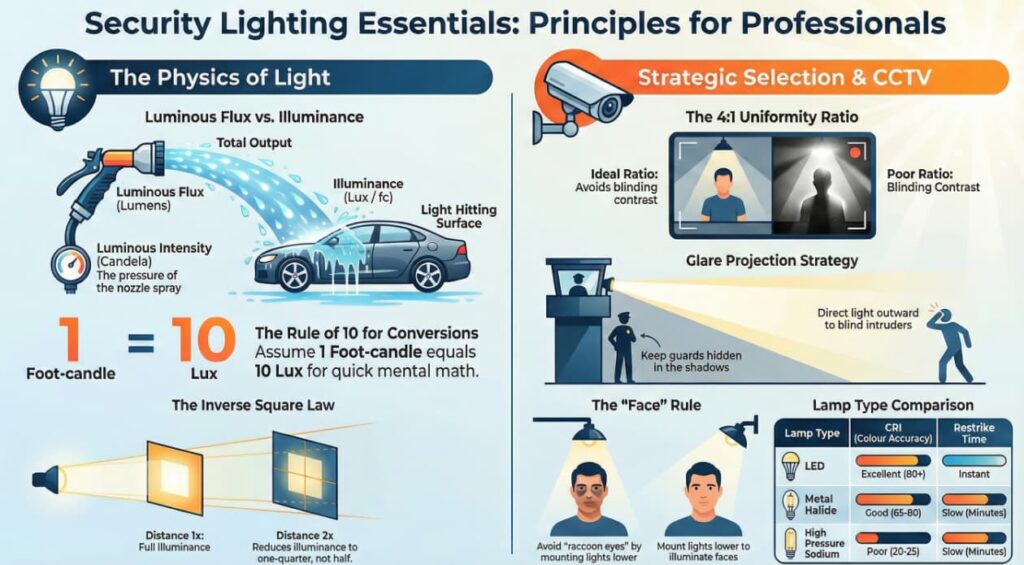
| Luminous Flux | Total light output emitted by a source. | The water flowing out of a hose. | Lumens (lm) |
| Illuminance | The density of light falling on a surface area. | The water hitting the car you are washing. | Lux (lx) or Foot-candles (fc) |
| Luminous Intensity | The brightness of the light in a specific direction. | The pressure of the nozzle spray. | Candela (cd) |
2. Measurement and Conversion ( The “Math” Section)
The PSP exam requires you to know the relationship between metric (Lux) and imperial (Foot-candles) units.
A. The Conversion Formula
1 Foot-candle (fc) = approx 10.76 Lux (lx)
- Rule of Thumb: For quick mental math during the exam, use a factor of 10.
- Example: If a camera requires 2 fc, that is roughly 20 lux.
- Example: 50 lux is roughly 5 fc.
B. The Inverse Square Law
Light intensity drops off drastically as you move away from the source.
- The Law: Illuminance is inversely proportional to the square of the distance. E = I/D^2
- Practical Application: If you double the distance from the light source, you get one-quarter (1/4) of the light, not half.
- Scenario: A light provides 4 fc at 10 feet. At 20 feet, it provides only 1 fc.
3. Lamp Types and Characteristics
You do not need to be an electrician, but you must know which bulb to choose for specific environments.
A. Key Characteristics to Evaluate
- Efficacy (Efficiency): How many Lumens per Watt? (Higher is cheaper to run).
- CRI (Color Rendering Index): Scale of 0-100. How accurately does the light show colors?
- Critical: If a witness sees a “blue car” but the light makes it look “black,” your evidence is flawed.
- Daylight = 100 CRI.
- Strike/Restrike Time: How long does it take to turn on?
- Strike: Time to reach full brightness from cold.
- Restrike: Time to turn back on after a momentary power glitch.
B. Common Lamp Types
| Lamp Type | CRI (Color) | Efficiency | Restrike Time | Best Use |
| Incandescent/Halogen | High (100) | Very Low | Instant | Rarely used (too expensive to run). |
| Fluorescent | Good (70-80) | Moderate | Fast | Indoors, Parking garages. Cold weather issues. |
| High Pressure Sodium (HPS) | Poor (20-25) | High | Slow (min) | Street lights, Foggy areas. Produces Yellow/Orange light. |
| Metal Halide (MH) | Good (65-80) | High | Slow (min) | Stadiums, Car dealerships (White light). |
| LED (Light Emitting Diode) | Excellent (80+) | Very High | Instant | The modern standard for almost all security lighting. |
Exam Trap: Low Pressure Sodium (LPS) has the highest efficiency but the absolute worst CRI (Monochromatic Yellow). Everything looks black and yellow. Do not use for color CCTV.
4. Lighting Application Strategies
How do we arrange the lights?
- Continuous Lighting: The most common. A series of lights arranged to flood a given area continuously during darkness.
- Glare Projection: Lighting directed outward from the perimeter.
- Effect: Blinds the intruder while hiding the guard behind the light. Used in prisons or high-security borders.
- Standby Lighting: Lights are off until triggered (automatically by sensors or manually).
- Controlled Lighting: Controlling the beam width to light a specific strip (e.g., a perimeter fence) without light pollution spilling into the neighborhood.
Real world tip: The “Light Pollution” Complaint: You design a bright perimeter for security. The residential neighbors scream about light shining in their bedroom windows.
Tip: Use “Full Cutoff” fixtures (shoe-box style) that direct light 100% downward, with zero horizontal bleed. It keeps the neighbors happy and the light where you need it.
5. Lighting for CCTV
Cameras are pickier than human eyes.
- Uniformity Ratio: Cameras struggle with high contrast (bright spots and dark shadows).
- The ratio of Average-to-Minimum light should ideally be 4:1 or better for CCTV.
- The “Face” Rule: For facial recognition, the light must hit the face, not just the top of the head. Avoid “down-lighting” that creates dark shadows in eye sockets (raccoon eyes).
- Solution: Mount lights lower or reflect light off pavement.