Back to: Data Center Physical Security Professional
Lesson 1.3: Regulatory & Compliance Standards
1. Learning Objectives
By the end of this lesson, you will be able to:
- Identify the key regulatory frameworks governing data centers (ISO 27001, PCI-DSS, SOC 2, HIPAA).
- Translate “administrative” compliance requirements into “physical” security controls.
- Prepare for a physical security audit by maintaining the correct evidence and logs.
2. The Bridge: Why Cyber Standards need Physical Security
Most regulations are written for Information Security, but they all contain a fundamental truth: You cannot secure data if you cannot secure the server it lives on.
If an attacker can physically steal a hard drive, no amount of firewalls or encryption can fully protect the organization. Therefore, almost every major cybersecurity framework has a dedicated section for Physical & Environmental Security.
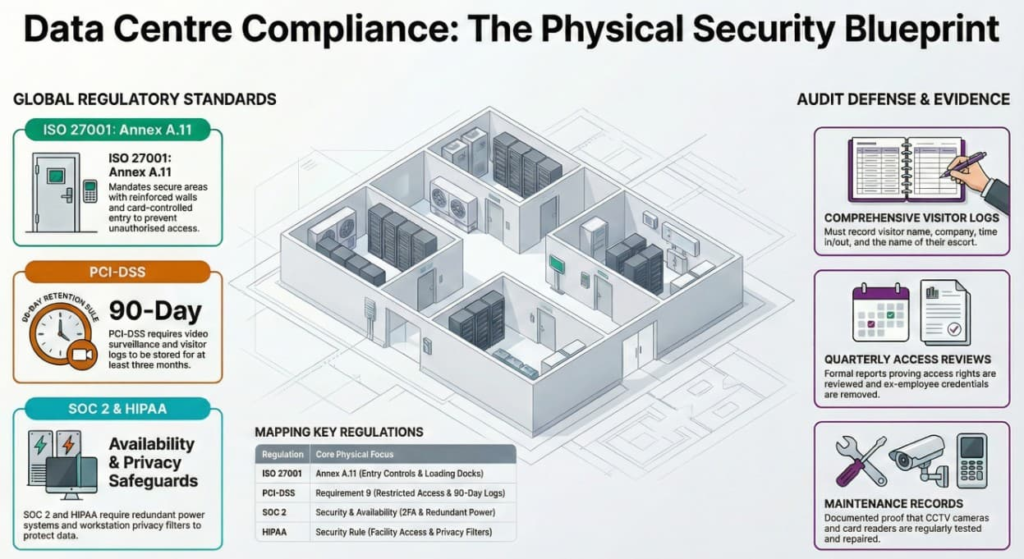
3. ISO/IEC 27001 (The Global Standard)
ISO 27001 is the international standard for Information Security Management Systems (ISMS). It is the most common certification data centers seek to prove they are secure.
Focus Area: Annex A.11 (Physical and Environmental Security) This section specifically mandates controls to prevent unauthorized physical access.
- A.11.1 Secure Areas:
- Perimeter: Strength of walls and card controlled doors.
- Entry Controls: Logging visitors, date/time stamps, and escort policies.
- Delivery & Loading: Segregating loading docks from the data hall (so a delivery driver can’t walk into the server room).
- A.11.2 Equipment:
- Siting & Protection: Protecting equipment from environmental threats (fire, flood) and unauthorized access.
- Clear Desk/Clear Screen Policy: Ensuring sensitive info isn’t left on desks in the SOC.
4. PCI-DSS (Payment Card Industry Data Security Standard)
If the data center hosts any servers that process credit card transactions (Visa, Mastercard, etc.), it must comply with PCI-DSS. This is one of the most prescriptive standards for physical security.
Focus Area: Requirement 9 (“Restrict physical access to cardholder data”)
- 9.1: Use appropriate facility entry controls (badges, locks) to limit and monitor physical access.
- 9.1.1: Use video cameras and/or access control mechanisms to monitor individual physical access to sensitive areas.
- Key Constraint: Data must be retained for at least 3 months (90 days).
- 9.2: Restrict physical access to publicly accessible network jacks (preventing someone from plugging a laptop into a lobby port).
- 9.4: Implement strict procedures for identifying and managing visitors (Visitor Logs must be kept for 3 months).
Pro Tip: In a PCI audit, the auditor will ask to see the video footage from exactly 89 days ago. If your system overwrites footage every 30 days, you fail the audit.
5. SOC 2 (Service Organization Control)
SOC 2 is an auditing procedure relevant to service providers (like Cloud Data Centers) who store customer data. It focuses on five “Trust Service Principles.”
Focus Area: The “Security” and “Availability” Principles
- Security: Prevents unauthorized access.
- Physical Control: Two-factor authentication (Biometrics + Badge) to enter the “White Space” (Data Hall).
- Availability: Ensures the system is up and running.
- Physical Control: Redundant power (Generators/UPS), fire suppression systems, and environmental monitoring (temperature/humidity sensors).
6. HIPAA (Health Insurance Portability and Accountability Act)
Relevant for US-based data or international data centers hosting US health data.
Focus Area: The Security Rule – Physical Safeguards
- Facility Access Controls: Procedures for validating access (e.g., verifying a repairman’s work order before letting them in).
- Workstation Use: Physical measures to shield screens from onlookers (privacy filters).
7. The Audit: “If it isn’t written down, it didn’t happen”
A large part of a Physical Security Manager’s job is Audit Defense. You must prove to the auditor that your controls work.
Common Audit Artifacts (Evidence):
- Access Logs: Who entered the server room last Tuesday between 2:00 PM and 4:00 PM?
- Visitor Logs: A physical or digital logbook showing visitor name, company, time in, time out, and escort name.
- Access Rights Review: A quarterly report showing that you reviewed who has access to the data center and removed ex-employees.
- Maintenance Records: Proof that the CCTV cameras and card readers were tested and repaired.