Back to: Data Center Physical Security Professional
0
Lesson 6.3: Incident Reporting & Forensics
1. Learning Objectives
By the end of this lesson, you will be able to:
- Construct a legally defensible Incident Report using the “5 Ws.”
- Distinguish between Objective Facts and Subjective Opinions in writing.
- Maintain the Chain of Custody for physical and digital evidence.
- Conduct a “Post-Mortem” or After-Action Review (AAR) to improve future responses.
2. The Incident Report (The PIR)
The Post-Incident Report (PIR) is the official record of truth. It may be read by the CEO, the Insurance Adjuster, or a Judge.
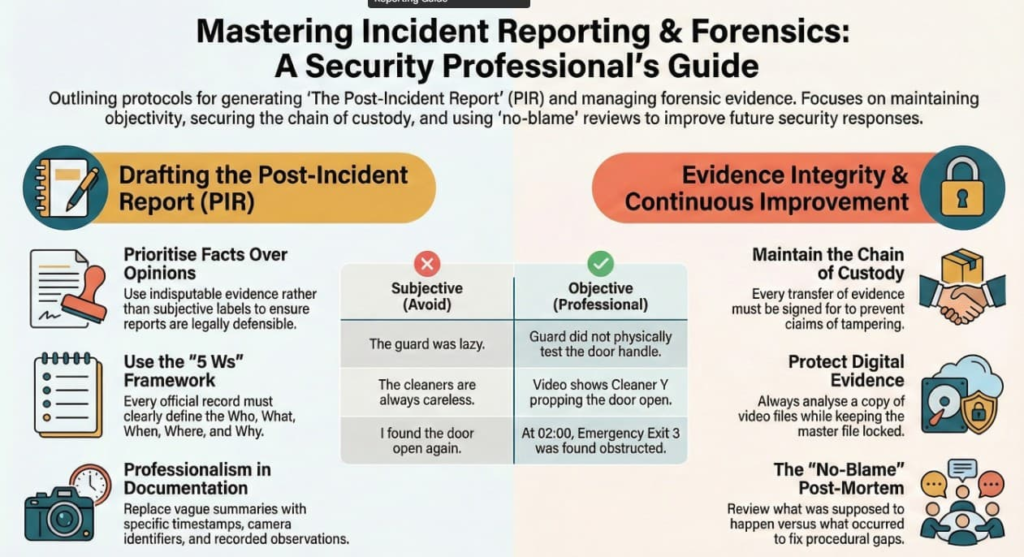
A. The Golden Rule: Facts, Not Opinions
- Bad (Subjective): “The guard was lazy and didn’t check the door properly.”
- Why it’s bad: “Lazy” is an opinion. The defense lawyer will destroy this.
- Good (Objective): “Video log 14:00:23 shows Guard Smith walking past Door 4 without physically testing the handle.”
- Why it’s good: This is an indisputable fact based on evidence.
B. The Structure: The 5 Ws
- Who: Who caused it? Who responded? Who was the victim?
- What: What happened? (Theft, Fire, Slip & Fall).
- When: Exact timeline (down to the second).
- Where: Specific location (e.g., “Aisle 4, Rack 12”).
- Why: The root cause (e.g., “Door lock battery failure”).
3. Evidence & Forensics
If you catch a thief but mishandle the video file, the thief walks free.
A. Chain of Custody
The Chain of Custody is a paper trail that proves nobody tampered with the evidence.
- The Log: Every time evidence changes hands, it must be signed for.
- Entry: “Jan 20, 14:00 – Hard Drive removed by Manager A.”
- Entry: “Jan 20, 14:15 – Hard Drive handed to Police Officer B.”
- The Gap: If there is an hour unaccounted for, the defense will argue someone planted fake evidence during that hour.
B. Digital Forensics (Video)
- Never analyze the original: Always make a copy of the video file and analyze the copy. Keep the master file locked (Read-Only).
- Watermarking: Professional VMS exports include a digital watermark. If someone tries to edit the video (e.g., cutting out 5 seconds), the watermark breaks, proving the file is corrupted.
4. The Post-Mortem (After-Action Review)
A crisis is a terrible thing to waste. After the dust settles, the team must gather for a “No-Blame” analysis.
The Three Questions:
- What was supposed to happen? (What does the SOP say?)
- What actually happened? (Did we follow the SOP? Did the equipment fail?)
- How do we fix the gap? (Do we need better training? Better radios? A new SOP?)
Example:
- Issue: The guards couldn’t find the keys to the server room during the fire alarm.
- Fix: Install a “Knox Box” (Key Safe) next to the door for emergency access.
5. Practical Application: Report Writing Exercise
Scenario: You found a door propped open with a brick at 2:00 AM.
- Draft 1 (Poor): “I found the back door open again. Probably the cleaners. They are always careless. I closed it.”
- Draft 2 (Professional):
- Time: 02:00 AM.
- Observation: During routine patrol, Officer X observed Emergency Exit 3 propped open by a red brick.
- Action: Officer X removed the obstruction and secured the door. Verified door was locked.
- Investigation: Review of CCTV camera 4 shows Cleaner Y placing the brick at 01:45 AM to take a smoke break.
- Resolution: Incident reported to Facilities Manager. Snapshot of video attached.