Back to: Data Center Physical Security Professional
0
Lesson 3.3: Visitor Management Protocols
1. Learning Objectives
By the end of this lesson, you will be able to:
- Define the “Sponsor” model and the responsibilities of an escort.
- Design a “Visitor Lifecycle” workflow from pre-registration to badge return.
- Implement visual management strategies (badge color coding) to instantly identify unauthorized solo movement.
- Differentiate between visitor types (Auditor, Vendor, Interviewee) and their access rights.
2. The Visitor Lifecycle
Security begins before the visitor arrives and ends only when they leave the property.
Phase 1: Pre-Registration (The “Sponsor”)
- Rule: No “pop-in” visits. All visitors must be registered in advance by an authorized internal employee (the “Sponsor”).
- Vetting: The Sponsor is responsible for vetting the business justification. Why do they need to be here?
- Notification: Security receives a list of expected names at the start of the shift. If a name isn’t on the list, they don’t get past the gate.
Phase 2: Arrival & Induction (The Lobby)
- Identity Verification: Government-issued photo ID (Passport/Driver’s License) is mandatory. The name on the ID must match the pre-registered name exactly.
- NDA (Non-Disclosure Agreement): Visitors often see proprietary hardware or client names. Signing an NDA is a condition of entry.
- Safety Briefing: A quick review of emergency exits and muster points.
- The “Assets In” Check: If a vendor brings tools or hard drives, these must be logged before entry to ensure they don’t leave with your assets later.
Phase 3: The Escort & Badge
- Badge Issuance: The visitor receives a temporary badge.
- Handoff: The Security Guard does not let the visitor into the building. The Sponsor must come to the lobby to collect them.
Phase 4: Departure
- Badge Return: Visitor badges must be returned. A lost badge is a security incident.
- The “Assets Out” Check: Did they bring in a laptop? Check that they are leaving with only that laptop.
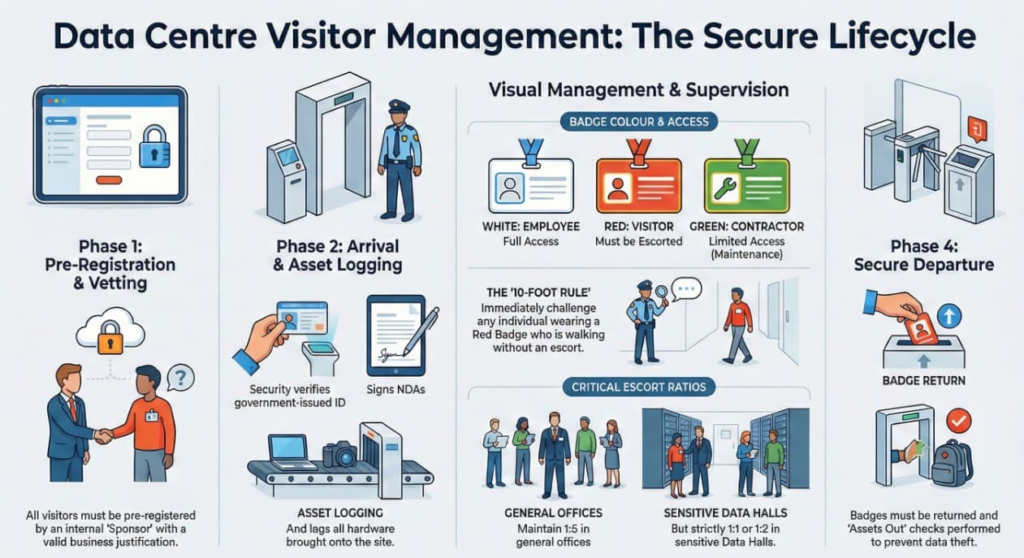
3. Visual Management: The Badge System
You should be able to look at a person down a long hallway and instantly know if they belong there.
- Color Coding:
- White: Employee (Full Access).
- Red: Visitor (Must be Escorted).
- Green: Contractor (Limited Access, usually maintenance).
- The “10-Foot Rule”: If you see a “Red Badge” walking alone, you must challenge them immediately. “Where is your escort?”
4. Escort Policies & Ratios
A visitor badge is essentially a “compliance leash.” It grants no access rights on its own; it only validates presence.
A. The Responsibilities of the Escort
- “Eyes-On” Supervision: The escort must keep the visitor in their line of sight at all times.
- Liability: If the visitor trips a breaker or steals a drive, the Escort is professionally liable.
- Tailgating: The escort swipes their badge, opens the door, and allows the visitor through. The visitor never swipes.
B. Escort Ratios
How many visitors can one employee handle safely?
- General Office: 1:5 (One employee can watch 5 visitors).
- Data Hall / Server Room: 1:1 or 1:2. The risk of accidental damage is too high to watch a large group.
5. Practical Application: Scenario Drills
Scenario A: The Pizza Delivery
- Situation: A delivery driver arrives with lunch for the night shift.
- Protocol: They do not enter the building. They stay at the reception desk/lobby transfer hatch. They are not issued a visitor badge.
Scenario B: The External Auditor
- Situation: An auditor from a bank arrives to inspect their specific server cage.
- Protocol:
- Check Govt ID.
- Issue “Visitor” badge.
- Escort (Sponsor) takes them directly to their cage.
- Constraint: They cannot wander into other aisles or look at other clients’ cages.
Scenario C: The “Forgot My ID”
- Situation: A high-level executive from a partner company arrives for a meeting but forgot their wallet/ID.
- Protocol:Deny Entry.
- Why? Social engineers often use authority (“Do you know who I am?”) to bypass rules. Without ID, there is no verification.