Back to: Data Center Physical Security Professional
Lesson 1.1: Data Center Tiers & Critical Infrastructure
1. Learning Objectives
By the end of this lesson, you will be able to:
- Differentiate between the four Data Center Tiers (I–IV) and their security implications.
- Define “Redundancy” regarding power and cooling (N, N+1, 2N).
- Identify critical infrastructure points (MMR, UPS, Chillers) that require specific physical security protocols.
2. The Tier Standard (Uptime Institute)
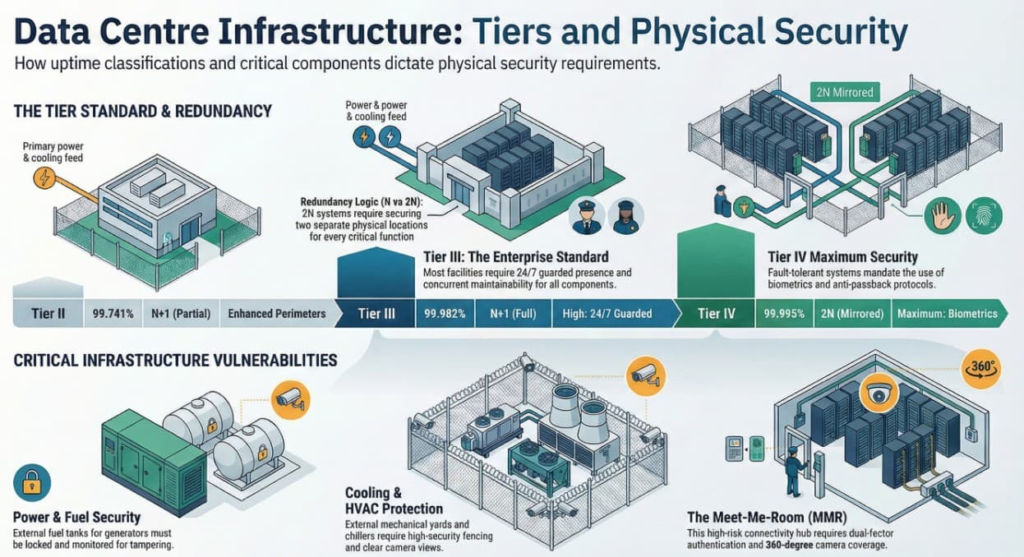
Data centers are classified by “Tiers” based on their uptime guarantees and redundancy. The higher the tier, the more critical the assets, and consequently, the stricter the physical security must be.
| Tier | Name | Uptime | Redundancy | Security Implication |
| I | Basic Capacity | 99.671% | N (No redundancy) | Basic access control. Usually low-criticality data. |
| II | Redundant Capacity | 99.741% | N+1 (Partial redundancy) | Enhanced perimeters. Failure of some components won’t stop ops. |
| III | Concurrently Maintainable | 99.982% | N+1 (Full redundancy) | High Security. Any component can be serviced without downtime. Requires 24/7 guarded presence. |
| IV | Fault Tolerant | 99.995% | 2N / 2N+1 (Full duplication) | Maximum Security. Fully mirrored systems. Biometrics and anti-passback are mandatory. |
Security Note: Most enterprise and colocation data centers you will secure are Tier III. This means they have multiple paths for power and cooling. You must know where the primary and redundant paths are located physically.
3. Understanding Redundancy: N vs. N+1 vs. 2N
Security professionals hear these terms often during facility tours or audits.
- N: The base requirement to run the facility (e.g., 1 Generator needed for the load).
- N+1: The base requirement plus one backup (e.g., 2 Generators total. If one fails, the other takes over).
- 2N: Fully mirrored systems (e.g., Two completely separate power rooms, two separate generator yards).
Why this matters to Security:
If a facility is 2N, you have two separate physical locations to secure for every critical function. You cannot focus all resources on “Power Room A” and neglect “Power Room B.”
4. Critical Infrastructure Components
You are not just guarding servers; you are guarding the utilities that keep them alive.
A. Power Infrastructure
Power is the lifeblood of the data center. The flow generally looks like this:
Utility Feed $\rightarrow$ Transformers $\rightarrow$ Generators $\rightarrow$ UPS $\rightarrow$ PDUs $\rightarrow$ RacksShutterstockExplore
- Utility Feed: The physical power lines entering the property.
- Security Risk: Tampering or vandalism at the substation or transformer.
- Generators (Gensets): Diesel engines that run during outages.
- Security Risk: Fuel theft and battery theft. Is the fuel tank secured?
- UPS (Uninterruptible Power Supply): Massive battery rooms that bridge the gap between grid failure and generator startup.
- Security Risk: These rooms are high-hazard zones (fire/chemical). Access must be strictly limited to authorized engineers.
B. Cooling Infrastructure (HVAC)
Servers generate immense heat. If cooling fails, servers melt down in minutes.
- CRAC/CRAH Units: The air conditioners inside the server halls.
- Chillers/Condensers: Often located outside the building or on the roof.
- Security Risk: Because these are external, they are vulnerable to drive-by attacks, drone surveillance, or vandalism. High-security fencing around external mechanical yards is mandatory.
C. Connectivity (The Meet-Me-Room)
- Point of Entry (POE): Where fiber optic cables enter the building from the street.
- Meet-Me-Room (MMR): The most sensitive room in the building. This is where internet carriers physically connect to the data center’s network.
- Security Risk: If an intruder cuts cables here, the entire facility goes offline. The MMR requires dual-factor authentication (Badge + Biometric) and 360-degree camera coverage.
5. Security Spotlight: Practical Application
Scenario: A Tier III Data Center.
Your Duty: Operational Rounds.
- The Perimeter: Check the Fuel Tanks. Are the caps locked? Is there evidence of tampering? (A generator with no fuel is useless).
- The Mechanical Yard: Check the Chillers. Is the fence line intact? Are there visual obstructions blocking the camera view of the pipes?
- The MMR: Verify the logbook. Only specific telecom engineers should be on the access list. Ensure the door was not propped open.