Back to: Data Center Physical Security Professional
Lesson 2.3: Exterior Surveillance & Detection
1. Learning Objectives
By the end of this lesson, you will be able to:
- Define PIDS (Perimeter Intrusion Detection Systems) and identifying the best types for data centers.
- Compare the advantages of Thermal Imaging vs. Standard Visual cameras in outdoor settings.
- Explain “Slew-to-Cue” integration.
- Differentiate between Fence-Mounted sensors and Volumetric (Microwave/Radar) sensors.
2. PIDS: The “Smart” Fence
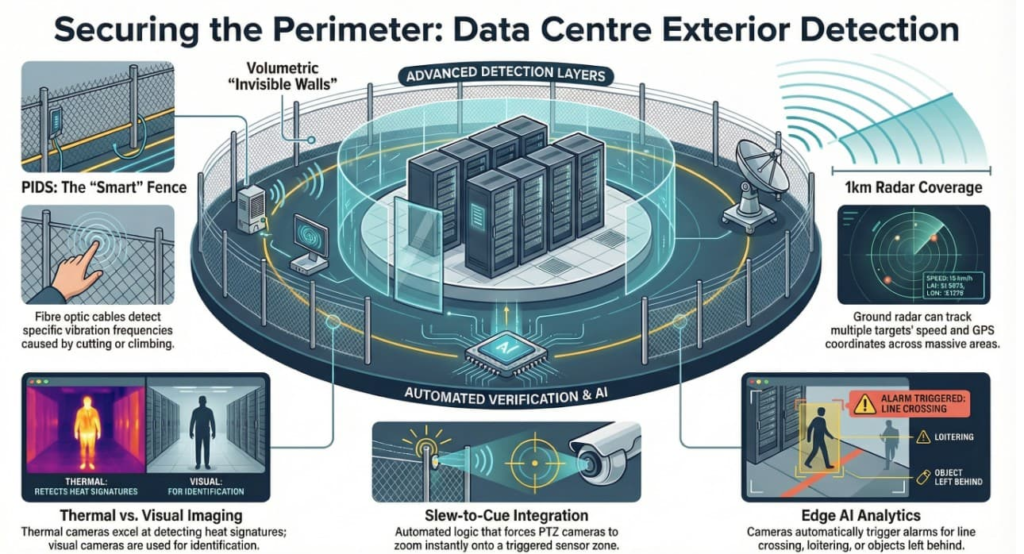
A Perimeter Intrusion Detection System (PIDS) turns a passive fence into an active alarm system. It detects the physical act of cutting, climbing, or lifting the fence fabric.
A. Fiber Optic / Vibration Sensors
This is the most common PIDS for data centers. A specialized cable is zip-tied along the entire length of the fence mesh.
- How it works: It analyzes vibration frequencies. Wind or rain creates a specific “noise” that is ignored. The sharp, erratic vibration of a saw or a boot climbing the mesh triggers an alarm.
- Zoning: The cable is logically divided into zones (e.g., Zone 1 = North Wall, Zone 2 = East Gate). This tells the SOC exactly where the attack is.
- Pros: Very low False Alarm Rate (FAR) if tuned correctly; immune to EMI/RFI interference.
3. Volumetric Detection (The Invisible Wall)
Sometimes you need detection behind the fence (the “sterile zone”) or in open areas where fences aren’t possible.
A. Microwave Barriers
- Setup: A Transmitter (Tx) and Receiver (Rx) are placed facing each other, creating an invisible “bean-shaped” field of microwave energy.
- Detection: If a person walks through the beam, the signal is disrupted, triggering an alarm.
- Use Case: ideal for the “Sterile Zone” (the empty space between the outer fence and the building wall).
B. Ground Radar
- Capabilities: Modern security radar can track multiple targets simultaneously, determine their speed, direction, and exact GPS coordinates.
- Advantage: Unlike cameras, radar works perfectly in pitch black, fog, rain, or blinding sun. It covers huge areas (up to 1km) with a single device.
4. Exterior Surveillance: Seeing the Threat
Once a sensor triggers, the SOC operator needs to see what is happening to verify if it’s a threat or just a stray dog.
A. Thermal vs. Visual Cameras
- Visual Cameras: Rely on light. If a brightly lit area has deep shadows, an intruder wearing black can hide.
- Thermal Cameras: Detect heat signatures. They do not need light. A human body glows bright white against a cool background.
- Pro Tip: Thermal is superior for detection (spotting a person), but Visual is required for identification (seeing their face/clothing). You often need both.
B. Analytics & AI
Modern cameras run AI at the “edge” (on the camera itself).
- Line Crossing: Draws a virtual line on the screen; if a person crosses it -> Alarm.
- Loitering: If a person stands in the parking lot for >2 minutes -> Alarm.
- Object Left Behind: If a backpack is dropped near the generator -> Alarm.
5. The “Slew-to-Cue” Integration
This is the gold standard for data center perimeters. It automates the response speed.
How it works:
- Trigger: The PIDS (Fence Sensor or Radar) detects an intrusion at Zone 4.
- Action: The system automatically grabs the nearest PTZ (Pan-Tilt-Zoom) camera.
- Slew: The camera physically spins and zooms in specifically on Zone 4.
- Result: The SOC operator looks at the screen and immediately sees the intruder, without having to manually search with a joystick.
Why this matters: In a stressful attack, operators make mistakes. Slew-to-Cue removes the human error of “looking in the wrong place.”
6. Practical Application: Designing the Layer
Scenario: You have a 358-mesh perimeter fence. There is a 10-meter gap of grass between the fence and the building.
Design Proposal:
- On the Fence: Install Fiber Optic PIDS cable to detect cutting/climbing.
- In the Grass (Sterile Zone): Install Microwave Barriers. If they jump the fence without touching it (ladder), the microwave catches them.
- Surveillance: Install Thermal Cameras on the building corners for night visibility.
- Logic: Configure Slew-to-Cue. If Fiber OR Microwave triggers, the Thermal camera snaps to that location.