Back to: Data Center Physical Security Professional
0
Lesson 4.2: VMS & Analytics
1. Learning Objectives
By the end of this lesson, you will be able to:
- Define the role of a VMS (Video Management System) in centralized security operations.
- Distinguish between “Pixel-based Motion Detection” and “AI Object Classification.”
- Implement specific analytics for data center risks: Loitering, Tailgating, and Object Removal.
- Explain the operational benefit of integrating VMS with Access Control (ACS).
2. The VMS (Video Management System)
The VMS is the software platform that aggregates streams from hundreds or thousands of cameras. It allows operators to view live footage, search recorded video, and manage alarms.
- Centralized Architecture: In a global data center network, a central SOC (Security Operations Center) might view feeds from facilities in London, Dubai, and Singapore simultaneously.
- Failover & Redundancy: If the primary recording server fails, the VMS must automatically switch to a backup server. (Remember the “N+1” concept from Module 1?).
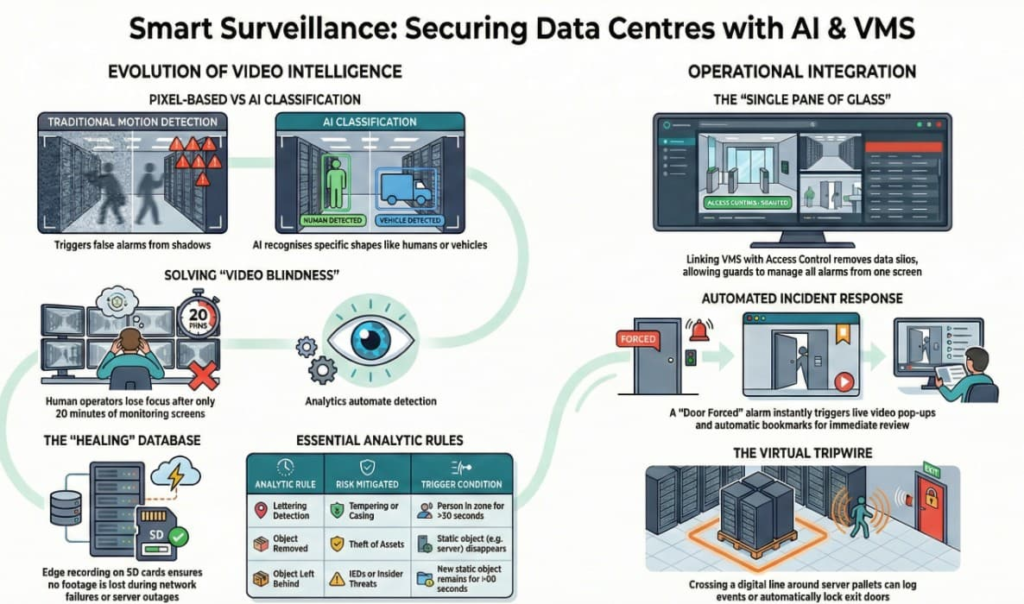
- Edge Recording: High-end cameras have SD cards. If the network goes down, the camera records locally. When the network returns, the VMS “heals” the database by pulling the missing footage from the camera.
3. Video Analytics: The Guard That Never Sleeps
Operators suffer from “Video Blindness” after just 20 minutes of staring at screens. Analytics automate the detection process.
A. Pixel-Based Motion Detection (The “Old” Way)
- How it works: The software looks for pixels changing color (e.g., a grey floor turns into black shoes).
- The Problem: It is “dumb.” A cloud passing over the sun, a spider web on the lens, or trees blowing in the wind will trigger thousands of false alarms.
- Verdict: Use only in strictly controlled indoor environments (like inside a windowless server room).
B. AI Object Classification (The “New” Way)
- How it works: The camera/software uses Deep Learning to recognize shapes. It knows what a human looks like, what a car looks like, and what a truck looks like.
- The Benefit: It ignores the spider web and the blowing trees. It only alerts if it sees a person or vehicle.
C. Critical Analytics for Data Centers
- Loitering Detection:
- Rule: If a person stands in the “Generator Yard” zone for >30 seconds.
- Risk: They might be tampering with fuel lines or casing the site.
- Object Removed:
- Rule: If a specific static object (like a fire extinguisher or a server box) disappears from the frame.
- Risk: Theft.
- Object Left Behind:
- Rule: If a new object appears and remains static for >60 seconds.
- Risk: Potential IED (Bomb) or insider threat leaving tools to wedge a door open.
4. The “Single Pane of Glass”: Integration
The most powerful feature of a VMS is its ability to talk to the Access Control System (ACS).
- The Silo Problem: In bad systems, the Guard sees a “Door Forced” alarm on the Access Control computer. They then have to roll their chair to the CCTV computer, type in the camera number, rewind to the time of the event, and look for the clip. This takes minutes.
- The Integrated Solution: The VMS and ACS are linked.
- Action: Someone forces a door.
- Reaction: The VMS automatically pops up the live video of that door on the main video wall and bookmarks the recording with the tag “Door Forced.”
- Result: The Guard sees the event as it happens.
5. Practical Application: Asset Protection
Scenario: You are protecting the “Staging Room” where expensive new servers sit before installation.
Configuration:
- Camera: High-resolution fixed camera covering the pallet of servers.
- Analytic: Set a “Virtual Tripwire” around the pallet.
- Rule:
- If a person crosses the line $\rightarrow$ Log event (Soft Alarm).
- If the pallet (Object) is removed $\rightarrow$ Trigger “Critical Alarm” in SOC + Lock the exit door automatically (Integration).