Back to: Data Center Physical Security Professional
Lesson 7.1: TVRA (Threat Vulnerability Risk Assessment)
1. Learning Objectives
By the end of this lesson, you will be able to:
- Define the core security equation: Risk = Threat x Vulnerability x Impact.
- Distinguish between a Threat (external force) and a Vulnerability (internal weakness).
- Use a 5×5 Risk Matrix to score risks and prioritize spending.
- Apply the four Risk Treatment strategies: Avoid, Mitigate, Transfer, Accept.
2. The Security Equation
You cannot eliminate all risks. You must calculate which ones matter.
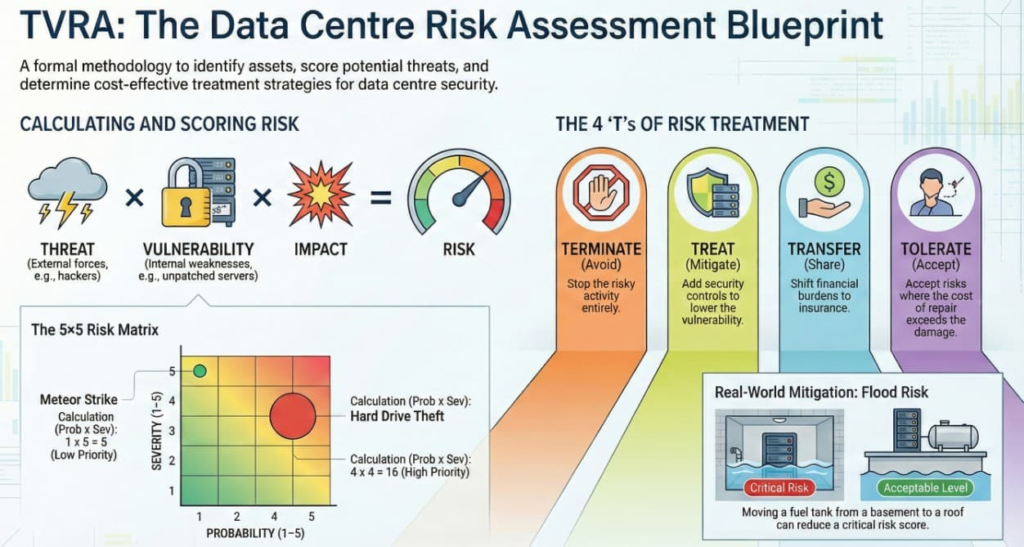
Risk = Threat x Vulnerability x Impact
- Threat: Anything that can cause harm (e.g., Earthquake, Thief, Hacker, Power Outage).
- Vulnerability: A weakness in your defense that allows the threat to succeed (e.g., No generator, Broken door lock, Unpatched server).
- Impact: The cost if the bad thing happens (e.g., $1M in lost revenue, loss of reputation, injury).
The Goal: We usually cannot change the Threat (we can’t stop the rain). We can reduce the Vulnerability (fix the roof) to lower the Risk.
3. The TVRA Methodology
A TVRA is a formal document created before a data center is built, and updated annually.
Step 1: Asset Identification
What are we protecting?
- Primary: The Data (Customer Information).
- Secondary: The Hardware (Servers, Generators).
- Tertiary: The People (Staff).
Step 2: Threat Assessment
What could hurt us?
- Natural: Flood, Fire, Earthquake, Lightning.
- Criminal: Theft, Vandalism, Terrorism, Industrial Espionage.
- Operational: Power failure, Cooling failure, Human error.
Step 3: Vulnerability Assessment
Where are we weak?
- Example: “The threat is a Truck Bomb. The vulnerability is that our building is only 5 meters from the road.”
4. Scoring: The Risk Matrix
We score every risk on a 1–5 scale to visualize them.
- Probability (Likelihood): 1 (Rare) to 5 (Almost Certain).
- Severity (Impact): 1 (Minor) to 5 (Catastrophic).
The Calculation:
- Scenario A (Meteor Strike): Probability (1) x Severity (5) = Risk Score 5 (Low).
- Scenario B (Hard Drive Theft): Probability (4) x Severity (4) = Risk Score 16 (High).
The Result: You spend your budget fixing Scenario B, not Scenario A.
5. Risk Treatment Strategies
Once you have a score, you have four choices (The 4 Ts):
- Terminate (Avoid): Stop the activity that causes the risk.
- Example: Risk of flooding is too high. Solution: Do not build the data center in that city.
- Treat (Mitigate): Add security controls to lower the score.
- Example: Risk of truck bomb. Solution: Install K12 Bollards (Mitigation). Now the risk is lower.
- Transfer (Share): Shift the financial burden to someone else.
- Example: Fire risk. Solution: Buy Insurance. If it burns down, the insurance company pays.
- Tolerate (Accept): The cost of fixing it is higher than the cost of the damage.
- Example: The risk of a meteor hitting the roof. Solution: Do nothing. It’s too expensive to build a meteor-proof roof for such a rare event.
6. Practical Application: Running a TVRA
Scenario: A Data Center in a tropical city.
- Threat: Hurricane (High Probability: 4).
- Vulnerability: The generator fuel tank is located in the basement (flood prone).
- Impact: If it floods, generators fail -> Total outage (Catastrophic: 5).
- Initial Risk Score: 4 x 5 = 20 (Critical).
Proposed Treatment (Mitigate):
- Move the fuel tank to the roof.
- New Vulnerability Score: Low (1).
- New Risk Score: 4 x 1 = 4 (Acceptable).