Back to: Data Center Physical Security Professional
Lesson 1.2: The “Defense in Depth” Methodology
1. Learning Objectives
By the end of this lesson, you will be able to:
- Explain the concept of “Concentric Rings of Security” (The Onion Model).
- Apply the “4 Ds” of physical security (Deter, Detect, Delay, Deny) to data center design.
- Analyze how different security technologies function within different layers.
2. The Concept: Concentric Rings of Security
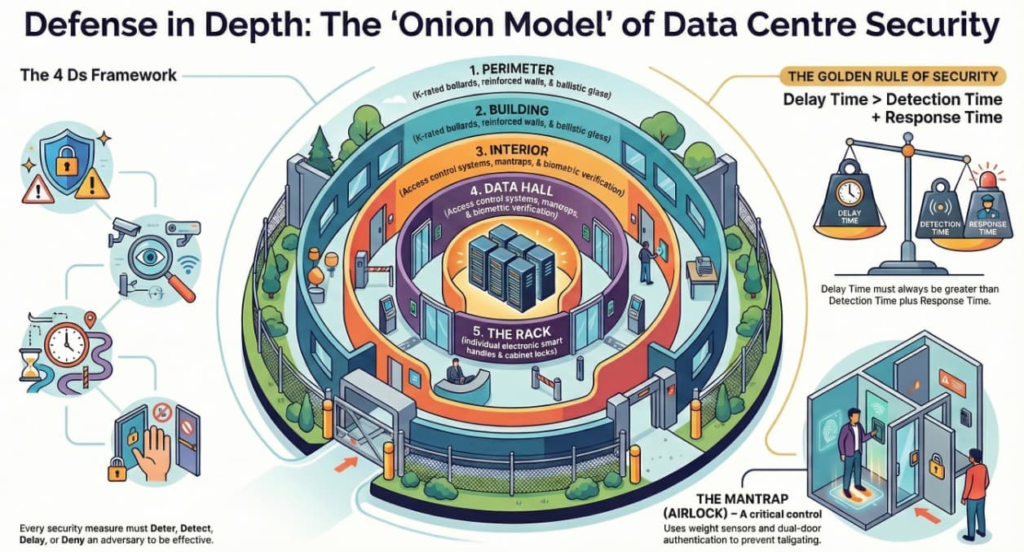
Imagine a data center like a medieval castle or an onion. The most valuable asset (the data) is in the center. To get there, an intruder must penetrate multiple distinct layers of protection.
Layer 1: The Perimeter (The Property Line)
- Goal: Keep the public out and define the boundary.
- Assets Protected: The site itself, parking, external utilities (generators/chillers).
- Controls: Anti-climb fencing (typically 8ft+), K-rated bollards (anti-ram), exterior lighting, and signage.
Layer 2: The Hardened Shell (The Building)
- Goal: Validate identity before allowing entry into the facility.
- Assets Protected: Staff, offices, loading docks.
- Controls: Reinforced concrete walls, ballistic glass, lobby security guards, and optical turnstiles. This is usually where the Security Operations Center (SOC) is located.
Layer 3: The Interior Zones (Movement Control)
- Goal: Segregate authorized personnel. (Just because you work in the building doesn’t mean you can go everywhere).
- Assets Protected: Meet-Me-Rooms (MMR), UPS rooms, corridors leading to data halls.
- Controls: Access Control Systems (Card Readers), Mantraps (airlocks), and internal CCTV.
Layer 4: The Data Hall (The “White Space”)
- Goal: The highest level of verification. Only IT technicians and authorized escorts belong here.
- Assets Protected: The server rows.
- Controls: Biometric authentication (Iris/Fingerprint), floor-to-ceiling turnstiles, and “No Tailgating” protocols.
Layer 5: The Rack (The Specific Asset)
- Goal: Prevent tampering with specific hardware.
- Assets Protected: Hard drives and blades.
- Controls: Individual cabinet locks (keyed or electronic smart handles).
3. The Strategy: The 4 Ds
Every security measure you install must fulfill one of these four functions. In a high-security data center, we aim to combine them.
| Function | Definition | Data Center Example |
| 1. Deter | Discourage the adversary from attempting the attack. | “Warning: Area Under Surveillance” signs, high-visibility perimeter lighting, uniformed guards patrolling. |
| 2. Detect | Identify the intrusion as soon as it happens. | Fence vibration sensors, motion detectors, CCTV analytics, door contact alarms. |
| 3. Delay | Slow the adversary down to buy time for response. | K-rated fences, magna-locks on doors, mantraps (which force a pause), hardened walls. |
| 4. Deny | Stop the adversary from proceeding. | A heavy steel door that stays locked, a guard physically intercepting the intruder. |
The Golden Rule of DiD:
The time it takes to Delay an intruder must be longer than the time it takes to Detect + Respond.
$$Delay Time > (Detection Time + Response Time)$$
4. Deep Dive: The Mantrap (Airlock)
The Mantrap is a classic example of Defense in Depth found in Layer 3 or 4.
- Deter: The complexity of the door system discourages casual tailgating.
- Delay: You must open Door A, enter the small room, wait for Door A to close and lock, authenticate again, and then open Door B. This slows movement significantly.
- Detect: Sensors inside the mantrap can detect if more than one person is inside (anti-tailgating weight sensors or overhead cameras).
- Deny: If the system detects two people, or if the second authentication fails, Door B will simply not open, trapping the intruder or forcing them back out.
5. Practical Application Scenario
The Scenario: An unauthorized person tries to enter the Server Hall to steal a hard drive.
- Layer 1 (Perimeter): They see a fence and cameras (Deter). They decide to jump the fence anyway.
- Layer 1 (Perimeter): A fence sensor vibrates and alerts the SOC (Detect).
- Layer 2 (Building): They run toward the door, but it is a reinforced steel door requiring a badge (Delay).
- Response: Because the fence Detected them and the door Delayed them, the Guard Force arrives and apprehends them before they breach the building (Deny).
Without Defense in Depth, the intruder would have walked straight to the server.