Back to: Data Center Physical Security Professional
Lesson 5.1: Background Screening & Vetting
1. Learning Objectives
By the end of this lesson, you will be able to:
- Identify the components of a comprehensive background check (Identity, Criminal, Financial, Employment).
- Explain the significance of BS 7858 (Security Screening Standard) and the “Gap Period” rule.
- Differentiate between “Pre-Employment Screening” and “Continuous Vetting.”
- Assess the risk of Financial Vulnerability as a vector for bribery or coercion.
2. The Insider Threat Reality
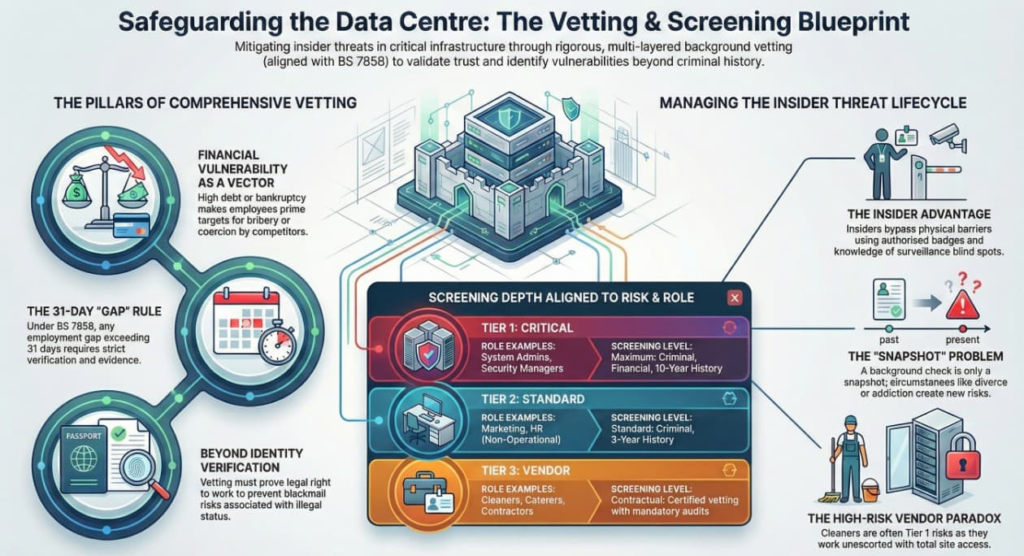
We often focus on external hackers, but an Insider has:
- Authorized Access: They don’t need to break the door; they have a badge.
- Knowledge: They know where the cameras have blind spots and where the backups are stored.
- Trust: They are often ignored by security guards who “know them.”
Vetting is the process of validating that Trust. It is not just about finding criminals; it is about finding people who are vulnerable or dishonest.
3. The Vetting Components (The “Deep” Check)
For critical infrastructure like a Data Center, a simple “police check” is insufficient. We look for patterns of behavior.
A. Identity & Right to Work
- Goal: Prove they are who they say they are.
- Check: Verify Passport/ID against government databases. Check work visa status (illegal workers are susceptible to blackmail).
B. Criminal Record Check
- Goal: Identify past behavior that indicates risk.
- Nuance: Not all crimes disqualify a candidate. A speeding ticket is fine; fraud, theft, or arson is a hard stop.
C. Financial & Credit Check
- Goal: Identify Financial Vulnerability.
- The Risk: An employee with massive gambling debt or impending bankruptcy is a prime target for a competitor or criminal gang offering cash for access ($10,000 to plug in a USB drive).
- Standard: We check for County Court Judgments (CCJs), bankruptcies, and high unsecured debt ratios.
D. Employment History (The 5-Year Rule)
- Goal: Verify honesty and continuity.
- The Standard (BS 7858): You must verify the last 5 to 10 years of employment history.
- The “Gap” Rule: Any gap in employment longer than 31 days must be explained and verified (e.g., “I was traveling” $\rightarrow$ Show us the plane tickets/passport stamps).
- Why? A 6-month unexplained gap could be prison time or working for a competitor.
4. Risk Tiers: Not Everyone Needs Top Secret
Screening should be proportional to the risk.
| Tier | Role Example | Screening Level |
| Tier 1 (Critical) | System Admins, Security Managers, Master Key Holders. | Maximum: Criminal + Financial + 10-Year History + Polygraph (in some sectors). |
| Tier 2 (Standard) | Marketing, HR (Non-Operational). | Standard: Criminal + 5-Year History. |
| Tier 3 (Vendor) | Cleaners, Caterers. | Contractual: The vendor company must certify they have vetted their staff, but you must audit their process. |
Warning: Cleaners are often Tier 1 risks. They enter every room, work at night, and are often unescorted. Never underestimate the access of the janitorial staff.
5. Continuous Vetting (Re-Screening)
A background check is a snapshot in time.
- Scenario: You hire “Bob” in 2020. He is clean.
- Event: In 2022, Bob gets divorced and develops a gambling addiction.
- The Risk: In 2023, Bob is a high-risk insider, but his 2020 background check says he is safe.
The Solution:
- Periodic Re-checks: Re-run criminal and financial checks every 2–3 years for critical staff.
- “Clean Slate” Policy: Encourage employees to self-report arrests or financial trouble in exchange for support rather than firing.
6. Practical Application: Resume Red Flags
Scenario: You are reviewing a CV for a Senior Network Engineer.
The CV states:
- 2018–2020: Worked at Google.
- 2020–2021: “Freelance Consultant / Sabbatical.”
- 2021–Present: Current Job.
The Action:
- The “Freelance” period is a Red Flag.
- Investigate: Ask for tax returns, client invoices, or bank statements from that period. If they cannot prove they were working, this is an unverified gap. In a high-security environment, No Proof = No Hire.