Back to: Data Center Physical Security Professional
Lesson 2.2: Perimeter Barriers & Fencing
1. Learning Objectives
By the end of this lesson, you will be able to:
- Distinguish between standard fencing and “High Security” (Anti-Climb/Anti-Cut) fencing.
- Explain the “358” mesh standard.
- Interpret Vehicle Crash Ratings (K-Ratings vs. ASTM standards) for bollards and barriers.
- Select the appropriate gate types to prevent vehicle tailgating.
2. High-Security Fencing
Not all fences are created equal. A standard chain-link fence can be climbed in seconds or cut with simple pliers. Data centers require specialized fencing.
A. The Standard: “358” Welded Mesh
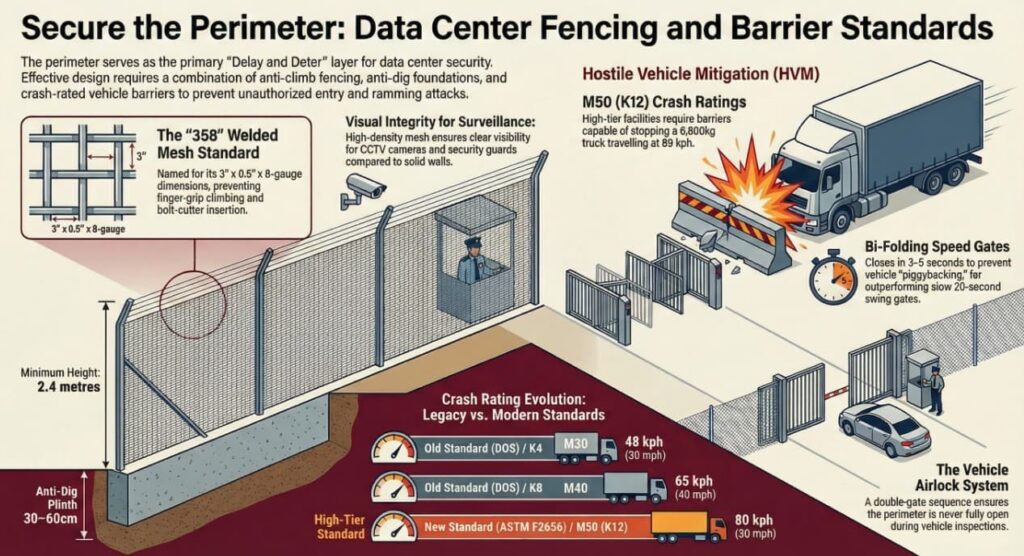
The gold standard for high-security perimeters is known as 358 Mesh (often called “Prison Mesh”).
- The Name: It comes from the measurements: 3 inches x 0.5 inches x 8 gauge.
- Anti-Climb: The apertures (holes) are too small for fingers or toes to get a grip.
- Anti-Cut: The small openings make it impossible to insert standard bolt cutters.
- Visibility: Despite being dense, it allows excellent visibility for CCTV cameras and guards looking through it (unlike a solid wall).
B. Height & Toppings
- Minimum Height: For a data center, the fence should be at least 2.4 meters (8 feet) high.
- Toppings: Coils of Razor Wire (concertina wire) or electrified pulse toppings are often added.
- Note: Check local laws. In some urban zones, razor wire is illegal or requires specific signage due to liability.
C. Buried Defense
- Anti-Dig: The fence should be buried 30–60cm into the ground, or sit on a concrete plinth, to prevent tunneling.
3. Hostile Vehicle Mitigation (HVM)
Fences stop people; they do not stop trucks. To stop a Vehicle-Borne Improvised Explosive Device (VBIED) or a ram-raid attack, you need heavy barriers.
A. Bollards & Barriers
- Fixed Bollards: Concrete-filled steel posts permanently installed to protect building corners or pedestrian paths.
- Active (Rising) Bollards: Hydraulically operated posts at entrances that lower to let authorized cars in and rise to stop threats.
- Wedge Barriers: Steel plates that rise from the road. These are generally stronger and more reliable than bollards for main gates.
B. Understanding Crash Ratings (K-Ratings & ASTM)
You will often see requirements for “K12” or “M50” rated barriers. These standards define what kind of impact the barrier can survive.
| Old Standard (DOS) | New Standard (ASTM F2656) | Performance (Stops a 15,000 lb / 6,800 kg Truck) |
| K4 | M30 | Stops truck traveling at 30 mph (48 kph) |
| K8 | M40 | Stops truck traveling at 40 mph (65 kph) |
| K12 | M50 | Stops truck traveling at 50 mph (80 kph) |
Requirement: Most Tier III/IV data centers require K12 / M50 rated barriers at all vehicle entry points.
4. Gate Dynamics
The gate is the weakest point of the fence. It is a moving part that introduces vulnerability.
A. Speed is Security
- The Risk: “Piggybacking.” An authorized car enters, and an unauthorized car speeds in behind them before the gate closes.
- The Solution: High-speed bi-folding gates.
- Swing Gate: Slow (15–20 seconds). Bad for high security.
- Bi-Folding Speed Gate: Fast (3–5 seconds). Ideal for data centers.
B. The “Vehicle Airlock”
Similar to the pedestrian mantrap, high-security vehicle entries use a double-gate system.
- Vehicle enters outer gate.
- Outer gate closes.
- Vehicle is inspected (undercarriage scan/visual check).
- Inner gate opens.This ensures the perimeter is never fully “open.”
5. Practical Application: Perimeter Design
Scenario: You are upgrading a facility that currently has a 6-foot chain-link fence and a simple swing gate.
- Critique:
- Chain link allows easy cutting/climbing.
- 6 feet is too low (easy jump).
- Swing gate allows tailgating.
- Upgrade Plan:
- Replace fence with 2.4m 358 Mesh with a concrete plinth (anti-dig).
- Install M50 (K12) rated bollards in front of the lobby glass and generator yard.
- Replace swing gate with a Bi-folding speed gate to reduce open/close time to <5 seconds.