Back to: Data Center Physical Security Professional
0
Lesson 6.2: Emergency Procedures (SOPs)
1. Learning Objectives
By the end of this lesson, you will be able to:
- Critique ineffective SOPs (walls of text) and create effective “Action Cards.”
- Explain the operation of VESDA (Very Early Warning Aspirating Smoke Detection) and Double Interlock sprinkler systems.
- Apply the Run-Hide-Fight protocol to an Active Shooter scenario.
- Differentiate between Fail-Safe and Fail-Secure lock states during a power outage.
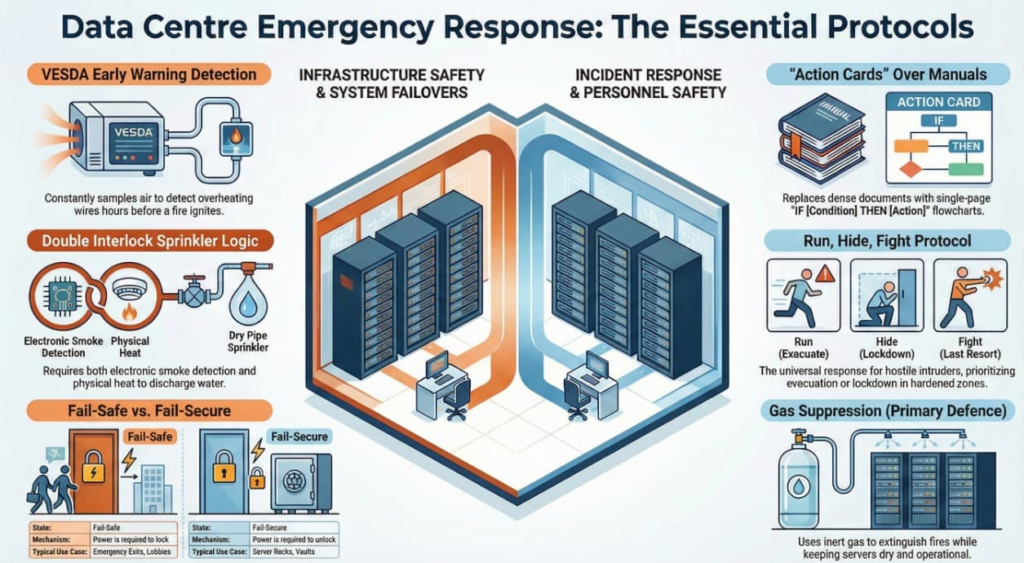
2. The SOP: Action Cards vs. Novels
In a crisis, nobody reads a 50-page binder.
- The Problem: Traditional SOPs are dense documents buried in a drawer.
- The Solution:Action Cards.
- A single-page, laminated sheet with a flowchart.
- Format: “IF [Condition] THEN [Action].”
- Example: “IF Fire Alarm sounds -> 1. Call 999 -> 2. Check Panel Location -> 3. Dispatch Guard.”
3. Fire Response: Protecting the Data
Fire is the #1 threat to a data center. Water is the #1 threat to servers. We need a system that puts out the fire without destroying the cloud.
A. Detection: VESDA
- What it is: Very Early Warning Aspirating Smoke Detection Air.
- How it works: It constantly “sniffs” the air through pipes. It can detect the microscopic chemical byproducts of a wire overheating hours before a visible flame appears.
- Action: VESDA allows the SOC to dispatch a technician to fix a smoldering wire before the sprinklers ever need to fire.
B. Suppression: Gas vs. Water
- Gas Suppression (Inergen / Novec 1230):
- Floods the room with inert gas. It extinguishes fire by lowering oxygen (or absorbing heat) but leaves the servers running and dry. Primary Defense.
- Double Interlock Pre-Action Sprinklers (Water):
- Fear: A pipe leaking and dripping water on a server.
- Solution: The pipes are normally filled with air, not water.
- Trigger 1: Smoke Detector trips -> Valve opens, water fills the pipe (but doesn’t spray).
- Trigger 2: The heat bulb on the sprinkler head melts -> Water sprays.
- Result: You need both electronic smoke detection AND physical heat to dump water.
4. Active Shooter / Hostile Intruder
Data centers are high-profile targets. The response protocol is universal.
A. Run (Evacuate)
- If there is an accessible escape path, attempt to evacuate the premises.
- Leave your belongings behind.
- Help others escape, but do not wait for them.
B. Hide (Lockdown)
- If evacuation is not possible, find a place to hide where the active shooter is less likely to find you.
- Hardened Zones: A Data Center is full of “Safe Rooms.” The Mantraps and Data Halls often have steel doors and no windows.
- Action: Silence cell phones. Blockade the door if it doesn’t lock.
C. Fight (Take Action)
- As a last resort, and only when your life is in imminent danger.
- Attempt to disrupt and/or incapacitate the active shooter.
- Tools: Fire extinguishers, chairs, hot coffee.
5. Power Failure: Fail-Safe vs. Fail-Secure
When the power dies (and the UPS fails), how do the doors behave? This is a critical life-safety vs. security decision.
- Fail-Safe (Life Safety):
- Mechanism: Power is required to lock the door (Maglock). If power is cut, the door unlocks.
- Use Case: Emergency Exits, Main Lobby. (People must be able to escape).
- Fail-Secure (Asset Protection):
- Mechanism: Power is required to unlock the door (Electric Strike). If power is cut, the door stays locked.
- Use Case: Server Racks, MMR, Cash Vaults. (We don’t want the vault to pop open just because the power went out).
- Key: There must be a mechanical override (key) for authorized staff.