Back to: Advanced Physical Security Integration (APSI)
0
Lesson 1.1: The Security Ecosystem – From Silos to Unification
Module: 1 – Foundations of Physical Security Architecture
Prerequisites: None
Estimated Time: 45–60 Minutes
1. Learning Objectives
By the end of this lesson, you will be able to:
- Define the modern physical security ecosystem and identify its core components.
- Trace the evolution of security technology from Analog (CCTV) to IP-based systems.
- Differentiate between “Closed Circuit” and “Networked” architectures.
- Explain why modern integration requires IT skills (networking, servers) alongside traditional trade skills (cabling, mounting).
2. The Historical Context: The “Analog” Era
To understand where we are, we must understand where we came from. For decades, physical security was defined by Hardware Isolation.
- Video (CCTV): The term “Closed Circuit Television” was literal. A camera was connected via a coaxial cable (RG59) directly to a monitor or recorder. It was a closed loop; no one outside the building could see it.
- Storage: VCR tapes were used, requiring guards to manually swap tapes every 24 hours.
- Limitation: If you wanted to view 16 cameras, you needed 16 cables running back to a massive head-end matrix.
- Access Control: Systems relied on proprietary Serial wiring (RS-485). If you bought Brand A’s controller, you were forced to use Brand A’s software forever.
- The “Silo” Problem: The Burglary Alarm did not talk to the Cameras. The Cameras did not talk to the Doors. If an alarm went off, a guard had to physically look at a separate panel, then walk to a separate monitor to see what happened.
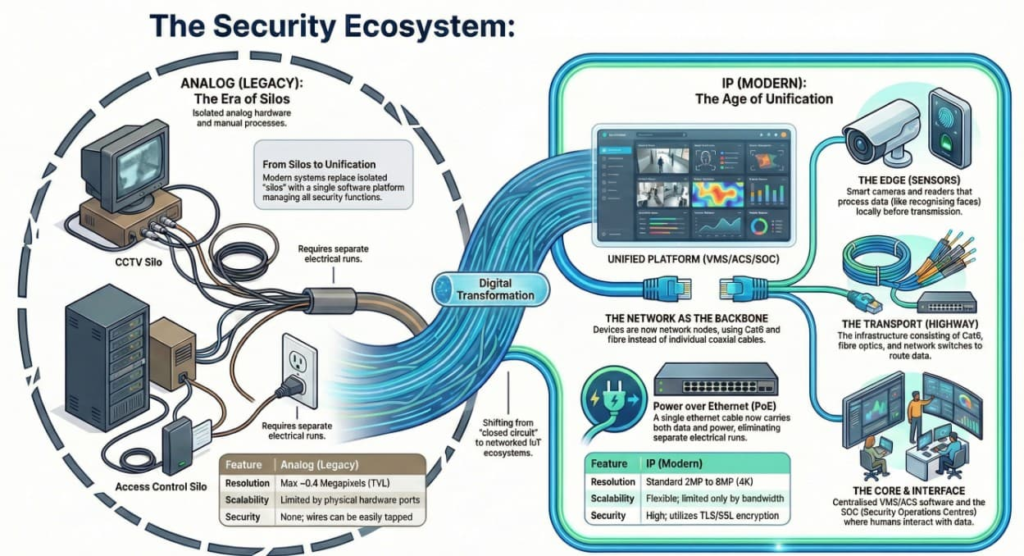
3. The Digital Transformation: The “IP” Era
The industry underwent a massive shift when security devices became Network Nodes.
- The IP Camera: An IP camera is essentially a computer with a lens. It has a CPU, memory, and a Network Interface Card (NIC). It digitizes video locally and sends data packets over the network.
- The Network as the Backbone: Instead of running 100 individual coax cables to a server room, we now run cables to a nearby Network Switch. That switch connects to the server via a single fiber or copper uplink.
- PoE (Power over Ethernet): We no longer need a separate electrician to run 110V/220V power to every camera location. The same ethernet cable carries both data and power (covered in Module 2).
4. The Modern Ecosystem Architecture
Today, a security integrator is building an IoT (Internet of Things) Ecosystem. The components are:
A. The Edge (Sensors)
These are the eyes and ears in the field.
- Cameras: Video and audio sensors.
- Readers: RFID/Bluetooth receivers for doors.
- Detectors: Motion (PIR), Glass break, Radar, Lidar.
- Trend: “Edge Computing” means these devices are smart enough to process data (like recognizing a face) before sending it to the server.
B. The Transport (Infrastructure)
The highway that data travels on.
- Cabling: Cat6 (Copper) and Fiber Optic.
- Switching: The traffic cops of the network that route data.
- Wireless: Wi-Fi, 4G/5G, or Point-to-Point microwave bridges for parking lots.
C. The Core (Processing & Storage)
The brain of the operation.
- VMS (Video Management System): Software that records and displays video (e.g., Milestone, Genetec).
- ACS (Access Control System): Database managing who can go where and when.
- Servers/Appliances: The physical hardware running the software.
- Cloud: Offloading storage and processing to remote data centers (AWS, Azure).
D. The Interface (Presentation)
How the human interacts with the machine.
- Workstations: Multi-monitor setups for security guards (SOC – Security Operations Centers).
- Mobile Apps: For roving guards or facility managers.
- Web Clients: Browser-based access for simple administration.
5. Comparison: Analog vs. IP
| Feature | Analog (Legacy) | IP (Modern) |
| Cabling | Coaxial (RG59) + Power Cable (18/2) | Ethernet (Cat6) |
| Power | Separate Power Supply Unit (PSU) | Power over Ethernet (PoE) |
| Resolution | Measured in TV Lines (TVL). Max ~0.4 Megapixels. | Measured in Megapixels. Standard is 2MP-8MP (4K). |
| Scalability | Limited by physical ports on the DVR (e.g., 16 channels). | Limited only by network bandwidth and server storage. |
| Intelligence | Dumb. Only records images. | Smart. Can detect motion, line crossing, objects, and faces. |
| Encryption | None. Anyone can tap the wire and see the video. | High. TLS/SSL encryption and password protection. |
6. Key Concept: “Unification” vs. “Integration”
- Integration: Two separate systems talking to each other.
- Example: When a door is forced open (Access Control), it sends a signal to the Video Recorder to popup a camera. They are still two separate pieces of software.
- Unification: One single software platform that manages everything natively.
- Example: Genetec Security Center. You do not switch windows between “Access” and “Video.” The door icon is overlayed on the video feed in the same interface.