Back to: Advanced Physical Security Integration (APSI)
Lesson 12.1: Codes & Standards (NEC & NFPA)
Module: 12 – Implementation, Codes & Closeout Prerequisites: Lesson 4.3 (Locking Hardware) & Lesson 9.2 (System Design) Estimated Time: 45–60 Minutes
1. Learning Objectives
By the end of this lesson, you will be able to:
- Identify when to use Plenum-rated (CMP) vs. Riser-rated (CMR) cabling based on airflow spaces.
- Apply NEC Article 725 to determine Class 2 and Class 3 low-voltage power limits.
- Execute proper Fire Stopping techniques when penetrating fire-rated walls (Red caulk vs. Putty pads).
- Cite NFPA 101 (Life Safety Code) requirements for delayed egress and maglock installations to pass the Fire Marshal’s inspection.
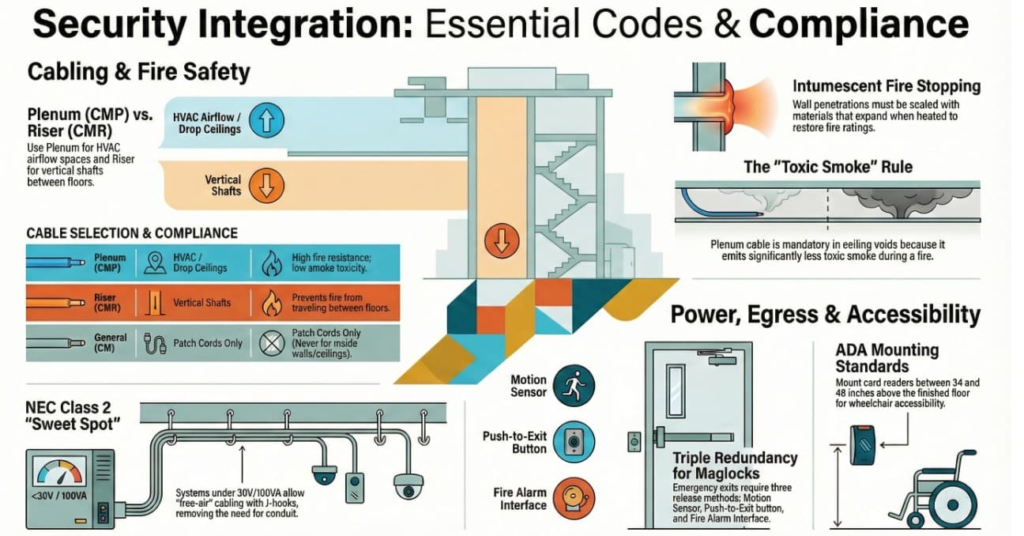
2. Cabling Ratings: Plenum vs. Riser (The Air You Breathe)
The code cares about one thing: Toxic Smoke. If a fire starts, your cable jacket melts. If that smoke gets sucked into the HVAC and blown into the rest of the building, it can kill people.
- Plenum Space: The space above a drop ceiling that acts as a return air duct for the HVAC.
- The Rule: You MUST use Plenum (CMP) rated cable. It burns slower and emits less toxic smoke.
- Visual: Usually has a white or distinct jacket. It is stiffer and more expensive (~30% more).
- Riser Space: Vertical shafts between floors.
- The Rule: Use Riser (CMR) rated cable. It prevents fire from climbing the cable like a fuse from Floor 1 to Floor 2.
- General Purpose (CM): Only for patch cords. Never run this inside ceilings.
Integrator’s Tip: If in doubt, buy Plenum. You can use Plenum anywhere, but you can only use Riser in non-plenum walls.
3. NEC Article 725: Low Voltage Power
The National Electrical Code (NEC) defines “Low Voltage.” Just because it’s 12V doesn’t mean it’s safe.
- Class 1: High power. Requires conduit. (Fire Alarms often fall here).
- Class 2:The Sweet Spot for Security.
- Limited voltage (usually < 30V) and limited power (< 100VA).
- Benefit: Does NOT require conduit (unless local code says so). You can “free-air” these cables using J-hooks.
- Application: PoE Cameras, Card Readers, Door Contacts.
- Class 3: Higher voltage/power, but still “Low Voltage.” (e.g., 70V Speaker lines).
Separation Rule: You cannot run Class 2 (Data/Security) in the same conduit or tray as Power (110V) unless there is a physical divider. The 110V causes interference (induction) and poses a shock hazard.
4. Fire Stopping (Restoring the Rating)
When you drill a hole through a firewall to run a cable, you have broken the firewall. You are legally required to fix it.
- The Material: You cannot use generic silicone. You must use Intumescent Fire Stop (Caulk, Putty, or Pillows).
- Intumescent: Means it expands when it gets hot, sealing the hole tight during a fire.
- The Code: ASTM E814.
- Common Violation: Stuffing a hole with steel wool or regular foam. This will fail inspection immediately.
5. NFPA 101: Life Safety & Locking
We touched on this in Module 4, but here is the Code Enforcement view. The Fire Marshal does not care about your security; they care about Egress.
The Maglock Rules (NFPA 101 – 7.2.1.6): If you install a Maglock (Fail-Safe) on an emergency exit, you generally need three redundant release methods:
- Motion Sensor (REX): Cuts power when you walk up to the door.
- Push Button (PTE): A green “Push to Exit” button that physically cuts the power (pneumatic or direct break). Must hold the door open for 30 seconds.
- Fire Alarm Interface (FAI): If the fire alarm trips, the magnet drops immediately.
The “Special Locking Arrangements” (Delayed Egress):
- Scenario: Someone pushes the bar, an alarm sounds for 15 seconds, then the door opens.
- Code: Only allowed in specific occupancies (Retail with sprinklers, Hospitals). Strictly forbidden in many Assembly or Educational occupancies without a variance.
6. ADA Compliance (Americans with Disabilities Act)
Security hardware must be accessible.
- Reader Height: Card readers must be mounted between 34″ and 48″ above the finished floor (AFF) so a person in a wheelchair can reach them.
- Door Force: If you add a heavy maglock, the door must still open with < 5 lbs of force (interior).
- Protrusion: Wall-mounted cameras cannot stick out more than 4 inches into a hallway if they are mounted lower than 80 inches (to prevent blind people from hitting their heads).