Back to: Advanced Physical Security Integration (APSI)
0
Lesson 5.2: Sensor Technology & Application
Module: 5 – Intrusion Detection & Perimeter Security Prerequisites: Lesson 5.1 (Alarm Panels) Estimated Time: 45–60 Minutes
1. Learning Objectives
By the end of this lesson, you will be able to:
- Explain the physics behind Passive Infrared (PIR) and Microwave detection.
- Justify the use of “Dual Technology” sensors to eliminate false alarms in harsh environments (warehouses, garages).
- Select the correct sensor for glass: Acoustic Glass Break vs. Vibration (Shock) Sensors.
- Position sensors correctly to avoid “Dead Zones” and environmental triggers (HVAC vents).
2. The Motion Sensor (PIR)
The Passive Infrared (PIR) sensor is the most common device in security, yet often misunderstood.
How it works:
- “Passive”: It does not emit anything. It only listens.
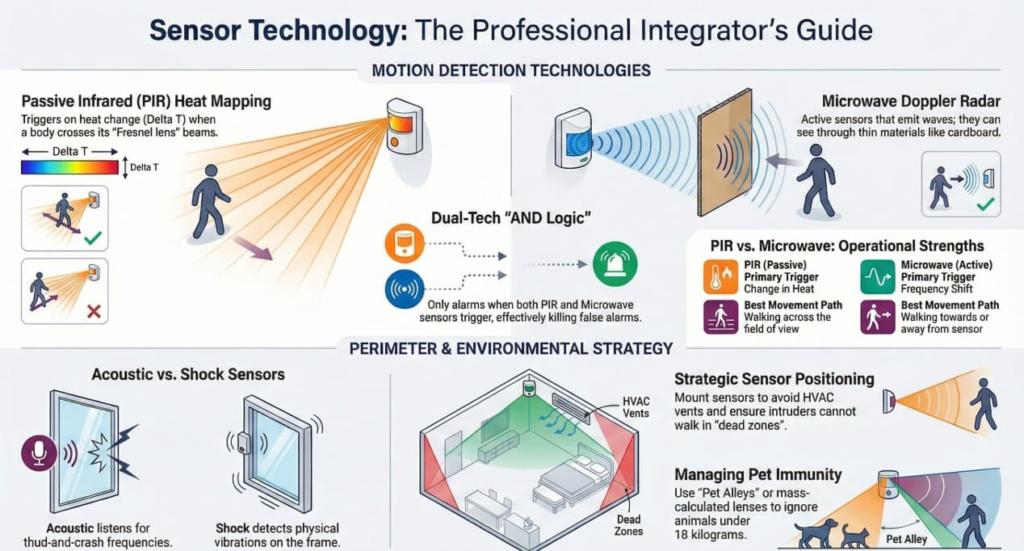
- Thermal Vision: It looks at the room and creates a “thermal map” of the background temperature.
- The Trigger: When a warm body (human/animal) moves across its field of view, the thermal energy changes rapidly. The sensor detects this Change in Heat Energy (Delta T).
The “Fingers” of Detection: Inside the lens (Fresnel Lens), the view is split into “fingers” or beams.
- If you walk towards the sensor, you might stay inside one finger (no alarm).
- If you walk across the sensor, you cross multiple fingers (ALARM).
- Field Tip: Always mount PIRs so the intruder walks across the path, not directly at it.
Weaknesses:
- Heat Sources: A blast of hot air from a heater vent or direct sunlight can fool it.
- Blockage: It cannot see through glass, paper, or boxes. If you stack inventory in front of it, it is blind.
3. Microwave Sensors (Doppler/Radar)
How it works:
- “Active”: It constantly emits microwave energy (Radio Waves).
- Doppler Effect: It measures how long it takes for the waves to bounce back.
- The Trigger: If an object is moving, the waves bounce back at a different frequency (Frequency Shift).
Strengths:
- Can see through cardboard, drywall, and wood. (Harder to block).
- Highly sensitive to movement towards/away from the sensor.
Weaknesses:
- Penetration: It can see through walls. A microwave sensor in a small office might detect people walking in the hallway outside, causing false alarms.
4. Dual Technology (Dual-Tech)
The “False Alarm Killer.” This sensor combines PIR + Microwave in one housing.
The Logic (AND Gate):
- PIR sees heat: “I think there is a person.”
- Microwave sees movement: “I think there is movement.”
- AND Logic: Only if BOTH sensors trigger at the same time does the panel send an alarm.
Use Cases:
- Warehouses with drafts (would trip PIR).
- Garages with bugs/birds.
- Areas with heavy sunlight.
5. Glass Break vs. Shock Sensors
Windows are weak points. We need to know if they break.
A. Acoustic Glass Break (The “Microphone”)
- How it works: Listens for specific frequencies.
- Thud: The low frequency of the object hitting the glass.
- Crash: The high frequency of the glass shattering.
- Requirement: Must hear BOTH the “Thud” and the “Crash” to alarm. (This prevents false alarms from dropping a drinking glass).
- Placement: Mounted on the ceiling or opposite wall, facing the window (usually 10-20ft range).
B. Shock Sensor (Vibration)
- How it works: Physically mounted on the window frame or glass. Detects the impact vibration.
- Use Case: High-security windows or thick plate glass that might not “shatter” loudly (e.g., laminated safety glass).
- Setting: Adjustable sensitivity (Low/Med/High) to ignore wind rattling.
6. Pet Immunity
Clients love their dogs. Sensors… not so much.
- How it works: The lens is designed to ignore the bottom 2 feet of the room (“Pet Alley”) or ignore objects under a certain mass (e.g., < 40 lbs).
- The Risk: A large dog (German Shepherd) or a cat jumping on a high shelf (entering the human zone) will still trip the alarm.
- Integrator’s Advice: If they have large pets, use Glass Breaks and Door Contacts instead of Motion Sensors.