Back to: Advanced Physical Security Integration (APSI)
0
Lesson 13.1: Electrical & Environmental Physics (Fieldcraft)
Module: 13 – Fieldcraft & Troubleshooting Scenarios Prerequisites: Lesson 12.5 (Installation Best Practices) Estimated Time: 45–60 Minutes
1. Learning Objectives
By the end of this lesson, you will be able to:
- Diagnose a “Ground Loop” by identifying rolling hum bars or intermittent reboots on outdoor cameras.
- Design a “Single Point of Ground” topology to prevent equipment failure during lightning storms.
- Apply Solar Geometry principles (Sun Path) to prevent seasonal blinding of camera sensors.
- Calculate the thermal load of a NEMA enclosure to prevent “The Greenhouse Effect” from cooking your NVR.
2. The Invisible Killer: Ground Loops
This is the #1 cause of “ghost” issues in outdoor security.
- The Physics: You think “Ground” (0V) is the same everywhere. It isn’t.
- Building A Ground: 0 Volts.
- Light Pole Ground (500ft away): Might be 5 Volts (due to soil resistance or nearby high-voltage leaks).
- The Problem: If you run a copper wire (Coax or Cat6 Shielded) between the Building and the Pole, you have connected 0V to 5V.
- Nature hates a difference. Current flows along your cable shield to equalize it.
- Result: This rogue current causes Horizontal Rolling Bars (Analog) or Packet Loss / Port Burnout (IP).
- The Fix:
- Isolation Transformer (GLI): A small device that magnetically passes the signal but breaks the physical copper path.
- The “Nuclear” Option (Fiber): Fiber optics are glass. They do not conduct electricity. Rule: If leaving the building footprint, use Fiber. It creates total galvanic isolation.
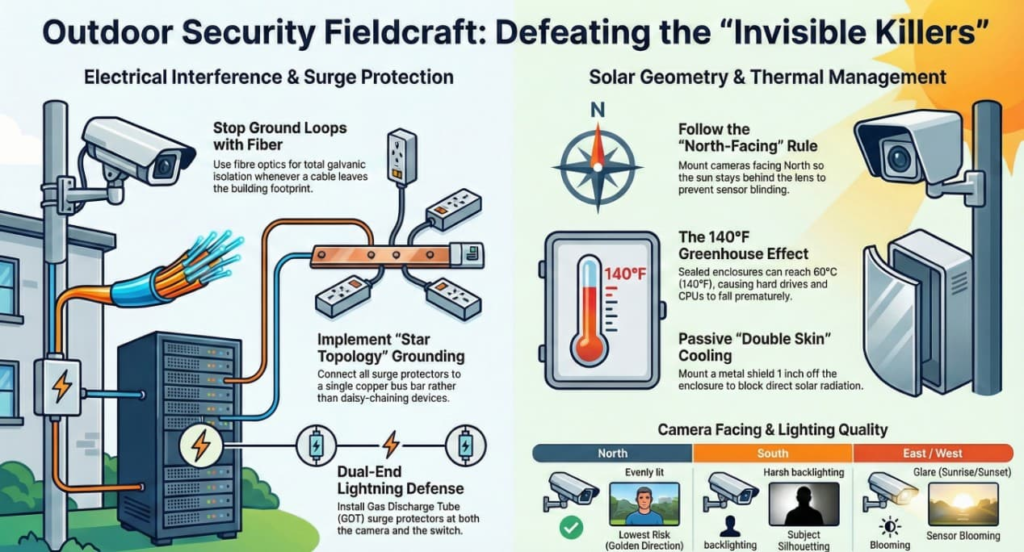
3. Lightning & Surge Protection
Lightning does not need to hit your camera to destroy it. It just needs to hit near it.
- Induction: A lightning strike creates a massive magnetic field. Any long wire (like a 300ft Cat6 run) acts as an antenna. The magnetic field induces a high-voltage spike on the wire.
- The Defense:
- Gas Discharge Tubes (GDT): These are surge protectors that “clamp” the voltage. If the voltage spikes above 60V, the gas ionizes and shorts the excess energy to ground instantly.
- Mounting: You need surge protection at BOTH ends:
- At the Camera (Pole).
- At the Switch (Head-end).
- The Trap (Daisy Chaining Grounds):
- Never daisy chain ground wires. Run a “Star Topology” where every surge protector goes to a single copper bus bar. If you daisy chain, the surge has to travel through Device A to get to ground, likely frying Device A.
4. Solar Geometry: The “North-Facing” Rule
A camera is an eye. If you stare at the sun, you go blind.
- The Problem: The sun moves.
- Winter: The sun is low in the southern sky (in the Northern Hemisphere).
- Summer: The sun is high.
- The Risk Zones:
- East/West: Worst. At Sunrise (East) and Sunset (West), the sun shines directly horizontally into the lens. WDR cannot fix this; the sensor is physically overwhelmed (blooming).
- South: Bad. Backlit subjects (silhouettes) most of the day.
- North: The Golden Direction. The sun is always behind the camera. The scene is evenly lit with no harsh shadows or glare.
- Field Tip: If you must face East/West, mount the camera higher and tilt it down steeply. The “eyebrow” (sunshield) of the camera will block the horizon.
5. Thermal Loading: The Greenhouse Effect
You put a 50W PoE switch and an NVR inside a NEMA enclosure on a pole.
- The Physics:
- Internal Heat: The electronics generate heat.
- Solar Gain: The sun hits the metal box.
- The Greenhouse Effect: A sealed IP66 box traps heat. The inside can reach 140°F (60°C) even on a 90°F day.
- Result: Hard drives fail (MTBF drops by 50% for every 10°C rise). NVR CPUs throttle and video stutters.
- The Fix:
- Color: Paint the box White or Grey. Never Black. White reflects solar radiation.
- Venting: Use “Active Ventilation” (Fans with filters). Heat rises; put the exhaust fan at the top and the intake vent at the bottom to create a chimney effect.
- The “Double Skin”: Mount a piece of sheet metal 1 inch off the surface of the box (Sun Shield). The sun hits the shield, air flows between the shield and the box, keeping the box cool.