Back to: Advanced Physical Security Integration (APSI)
0
Lesson 10.2: Hardware Ecosystems (The “Big Three” Categories)
Module: 10 – Product Selection & System Design Prerequisites: Lesson 3.1 (Camera Hardware) & Lesson 7.4 (Supply Chain) Estimated Time: 45–60 Minutes
1. Learning Objectives
By the end of this lesson, you will be able to:
- Categorize camera manufacturers into Premium (Axis), Mid-Market (Hanwha), and Budget/Banned (Hikvision/Dahua).
- Evaluate the “NDAA Impact” on hardware selection for US/Government-aligned projects.
- Justify the price difference between a $200 camera and a $1,000 camera (MTBF, Firmware, and Chipsets).
- Select the correct brand for specific verticals (e.g., Critical Infrastructure vs. SMB Retail).
2. The Premium Tier: Axis Communications
- Origin: Sweden (Invented the IP Camera in 1996), owned by Canon.
- The Reputation: The “Mercedes-Benz” of cameras.
- Key Chipset:ARTPEC.
- This is their proprietary System-on-Chip (SoC). Because they design their own chip, their image processing (WDR, Lightfinder) is generally superior to brands that use generic chips.
- Pros:
- Reliability: Extremely high Mean Time Between Failures (MTBF). You install it, and it runs for 10 years.
- Cybersecurity: Top-tier hardening. They publish an “SBOM” (Software Bill of Materials) so you know exactly what code is inside.
- Openness: Works perfectly with Milestone, Genetec, and others.
- Cons: Price. You pay a premium.
- Best For: Mission Critical (Airports, Data Centers), Harsh Environments (Oil & Gas).
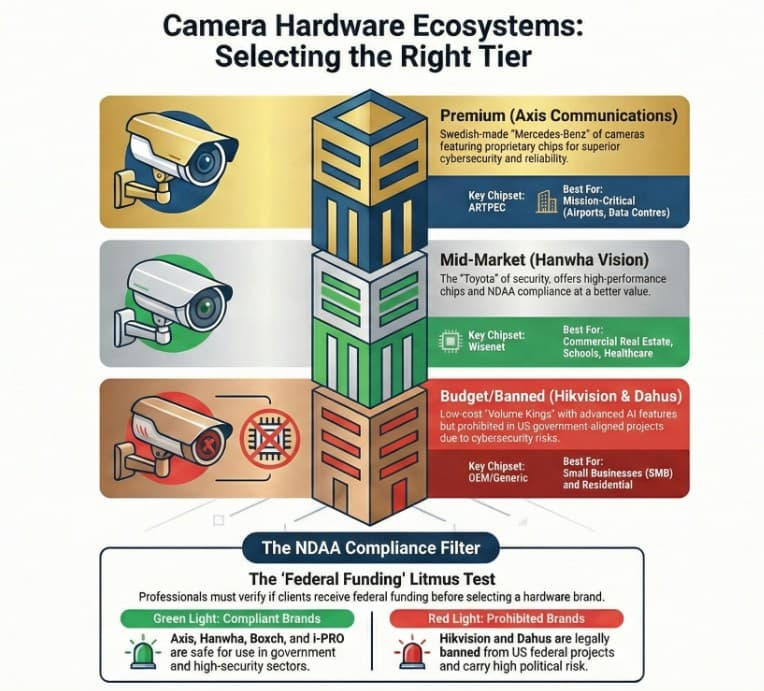
3. The Mid-Market Champion: Hanwha Vision (formerly Samsung)
- Origin: South Korea.
- The Reputation: The “Toyota/Honda.” High reliability, great performance, better price than Axis.
- Key Chipset:Wisenet.
- Known for excellent WDR (Wide Dynamic Range) and edge analytics.
- Pros:
- NDAA Compliant: Manufactured in Vietnam/Korea. Safe for government use.
- Value: You get 90% of the performance of Axis for 70% of the price.
- Supply Chain: Generally better stock availability than competitors.
- Cons: The web interface is slightly less polished than Axis, but still very good.
- Best For: Commercial Real Estate, Schools, Retail Chains, Healthcare.
4. The Budget / Banned Tier: Hikvision & Dahua
- Origin: China (State-owned or State-linked).
- The Reputation: The “Global Volume Kings.” They dominate the low-end market.
- Key Strategy:OEM (Original Equipment Manufacturer).
- You might buy a “Honeywell” or “Ademco” or “Trendnet” camera, but if you open it up, the board inside is Hikvision.
- Pros:
- Price: Unbeatable. A 4K camera might cost $150.
- Innovation: Because they have massive R&D budgets, their AI features (ColorVu, AcuSense) are actually quite advanced for the price.
- Cons:
- NDAA Ban: Illegal to use in US Federal Government projects (and many supporting industries).
- Cyber Risks: History of backdoors and “phoning home” vulnerabilities (Lesson 7.4).
- Political Risk: Many Western companies are ripping them out to avoid bad PR.
- Best For: Small Business (SMB), Residential, Gas Stations (where budget is the only factor).
5. The “NDAA” Filter (The Integrator’s Litmus Test)
Before you pick a brand, ask the client: “Do you receive federal funding?”
- If YES (Schools, Hospitals, Defense contractors):
- GREEN LIGHT: Axis, Hanwha, Bosch, Panasonic (i-PRO), Motorola (Avigilon/Pelco).
- RED LIGHT: Hikvision, Dahua, Hytera, Huawei.
- If NO (Private Coffee Shop):
- You can install Hikvision, but you must warn them about the cybersecurity risks (Port Forwarding is a huge “No” here).
6. Specialty Hardware (Niche Players)
Sometimes the Big Three don’t have the right tool.
- Bosch: Excellent for Perimeter Detection. Their built-in video analytics are arguably the best for detecting intruders at long range.
- Panasonic (i-PRO): Unbeatable Sensor Longevity. Their sensors resist coating degradation (rain/salt) better than most.
- Mobotix: Decentralized (Edge) Pioneers. Very popular in Europe. Fisheye specialists.