Back to: Advanced Physical Security Integration (APSI)
0
Lesson 3.1: Camera Hardware Deep Dive
Module: 3 – Video Surveillance (VMS & CCTV) Prerequisites: Module 2 (Networking) Estimated Time: 45–60 Minutes
1. Learning Objectives
By the end of this lesson, you will be able to:
- Differentiate between common form factors (Dome, Bullet, Turret, PTZ) and select the right one for specific environments.
- Explain the relationship between Lens Millimeter (mm) and Field of View (FoV).
- Analyze the trade-off between Resolution (Megapixels) and Low-Light Sensitivity.
- Critique the “Sensor Size” spec to predict night-time performance.
2. Form Factors: The “Body”
Choosing the shape of the camera is not just about aesthetics; it’s about maintenance and durability.
A. The Dome
- Description: Lens sits inside a plastic or glass bubble.
- Pros:
- Vandal Resistant (IK10): Hard to knock off the ceiling or redirect.
- Discreet: Hard for bad guys to tell where the lens is pointing.
- Cons (The “Integrator’s Headache”):
- IR Reflection: If the bubble gets dirty or the foam ring inside is loose, the Infrared light bounces off the glass and blinds the lens at night.
- Weather: Raindrops stick to the bubble, blurring the image. Avoid using standard domes outdoors without rain guards.
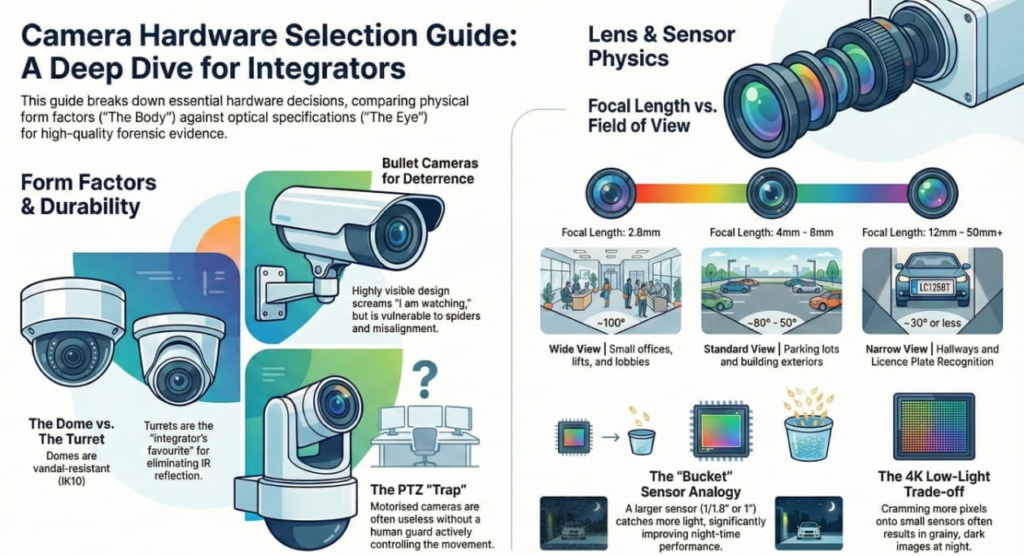
B. The Bullet
- Description: A long, cylindrical camera mounted on a bracket.
- Pros:
- Deterrence: Highly visible. It screams “I am watching you.”
- Range: Usually houses larger IR illuminators for long-distance night vision.
- Cons:
- Spiders: Spiders love building webs across the front face, which glow bright white under IR light.
- Vulnerability: easy to knock out of alignment with a stick.
C. The Turret (The “Eyeball”)
- Description: A ball-and-socket design. It looks like a dome but without the glass bubble.
- Pros:The Integrator’s Favorite.
- No IR Bleed: The lens and IR lights are separate and flush-mounted. No glass bubble means no reflection issues.
- Easy Adjustment: Rotates easily in any direction.
- Cons: Less vandal-resistant than a dome.
D. The PTZ (Pan-Tilt-Zoom)
- Description: A motorized camera that can move and zoom.
- The Trap: Clients love them (“I want to look everywhere!”), but they are often useless unless a human guard is actively controlling them. If the camera is looking Left, it is missing everything happening on the Right.
3. The Lens: The “Eye” (Focal Length)
The most critical spec for an integrator is the Focal Length, measured in millimeters (mm). This determines how “wide” or “zoomed” the picture is.
- The Rule:
- Lower Number (e.g., 2.8mm) = Wider View (Fish-eye effect). Objects look smaller.
- Higher Number (e.g., 12mm) = Narrower View (Telephoto). Objects look closer.
Common Lens Sizes & Applications:
- 2.8mm (Wide): ~100° view.
- Use: Small offices, lobbies, elevators, small rooms.
- Risk: “Pixel spread.” You see the whole room, but you can’t read a name tag.
- 4mm to 6mm (Standard): ~80° to 50° view.
- Use: Parking lots, building exteriors. Matches the human eye reasonably well.
- 12mm to 50mm+ (Telephoto): ~30° view or less.
- Use: Hallways, License Plate Recognition (LPR), shooting down a fence line.
Fixed vs. Varifocal:
- Fixed Lens: The mm is set at the factory (e.g., “This is a 2.8mm camera”). Cheap, simple, but zero flexibility.
- Varifocal Lens: You can adjust the zoom (e.g., “2.8mm to 12mm”).
- Motorized Zoom: You adjust it from your laptop during setup. Always buy motorized varifocal for high ceilings so you don’t have to climb a ladder to tweak the view.
4. The Sensor: The “Retina”
The image sensor (CMOS) captures the light.
- Size Matters: Sensors are measured in fractions of an inch (e.g., 1/3″, 1/2.8″, 1/1.8″, 1″).
- The “Bucket” Analogy: Imagine the sensor is a bucket catching rain (light). A wider bucket catches more rain.
- 1/2.8″ (Standard): Good for general use.
- 1/1.8″ (Large): Excellent for low light.
- 1″ (Huge): DSLR quality. Used in high-end traffic cameras.
5. Resolution vs. Low Light (The Trade-off)
Clients always ask for “4K” (8 Megapixels), assuming it is better. Not always.
- The Physics Problem: If you cram 8 million pixels onto a small sensor, each pixel is tiny. Tiny pixels cannot capture much light.
- The Result: A 4K camera often looks worse at night than a 1080p (2MP) camera. The 4K image will be grainy (“noise”) or dark.
Integrator’s Rule of Thumb:
- 2MP (1080p): The workhorse. Best low-light performance per dollar. Great for general surveillance.
- 4MP / 5MP: The “Sweet Spot.” Good detail, decent low light.
- 8MP (4K): Only use outdoors IF you have very bright stadium lighting. Otherwise, reserve 4K for sunny/bright indoor areas.