Back to: Advanced Physical Security Integration (APSI)
Lesson 10.3: Access Control Platforms (Open vs. Proprietary)
Module: 10 – Product Selection & System Design
Prerequisites: Lesson 4.1 (Architecture) & Lesson 9.2 (System Design)
Estimated Time: 45–60 Minutes
1. Learning Objectives
By the end of this lesson, you will be able to:
- Identify a “Mercury Board” by sight and explain why it is the “Golden Standard” for enterprise systems.
- Differentiate between “Open Hardware” (Lenel, Genetec, Feenics) and “Proprietary Hardware” (AMAG, Software House, Brivo).
- Evaluate the financial risk of “Vendor Lock-In” when choosing a proprietary system.
- Plan a “Takeover” strategy: knowing when you can re-use existing boards versus when you must “Rip and Replace.”
2. The Hardware Dilemma: Who makes the board?
When a client buys an Access Control System (ACS), they are buying two things:
- The Software: The interface on the computer (e.g., Lenel OnGuard).
- The Hardware: The green circuit boards in the closet that wire to the locks.
The relationship between these two determines the client’s future freedom.
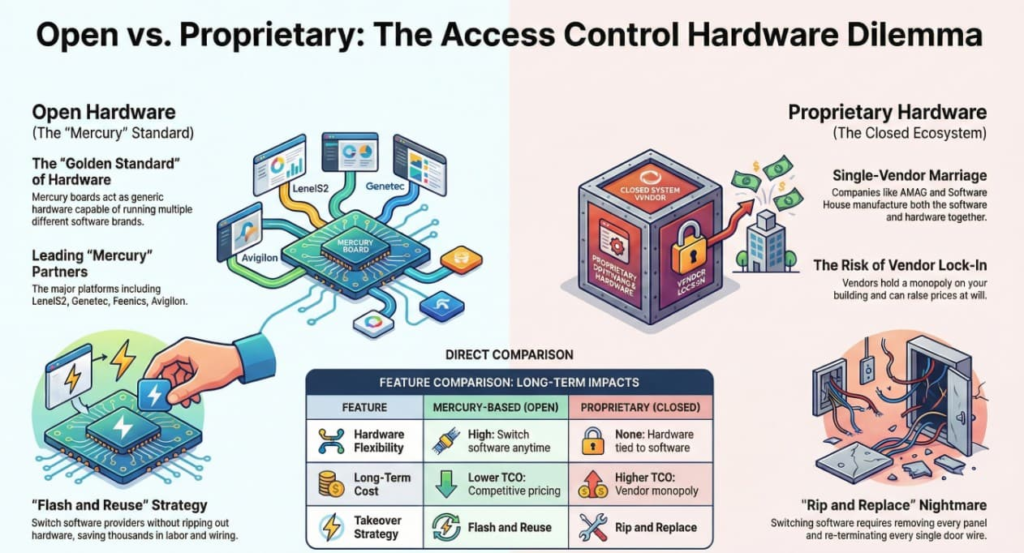
3. The “Mercury” Standard (Open Hardware)
Mercury Security (now owned by HID) is a manufacturer that makes the circuit boards, but does not make software. They sell their boards to software companies who put their own “firmware” on them.
- The Concept: Think of Mercury as a generic PC. You can run Windows (Lenel), Linux (Genetec), or Cloud OS (Feenics) on the exact same hardware.
- The Visual: They are distinctively green with red/black power blocks.
- LP1501 / LP1502: The Intelligent Controllers (The Brains).
- MR52 / MR50: The Downstream Interface Boards (The IO).
The “Mercury Partners” (Who uses them?):
- LenelS2 (OnGuard): The biggest player in the corporate world.
- Genetec (Synergis): The unified giant.
- Feenics: A modern cloud-based platform.
- Avigilon (ACM): Motorola’s access platform.
- RS2 / Open Options / Honeywell Pro-Watch.
The Benefit (Investment Protection):
If a client installs Lenel today but hates it 5 years from now, they do not have to rip out the hardware. You simply “flash” the Mercury boards with new firmware and install Genetec software. This saves the client tens of thousands of dollars in labor and wiring.
4. The “Proprietary” Standard (Closed Hardware)
These companies manufacture both the software and the hardware. They are designed to work perfectly together, but they generally do not play with others.
The Brands:
- Software House (C-Cure 9000): The “Rolls Royce” of proprietary. Extremely powerful, used in massive Fortune 500s. Bulletproof, but you are married to them for life.
- AMAG (Symmetry): Very popular in government/military. Unique wiring topology (often uses “Chain” wiring rather than Star).
- Gallagher: New Zealand-based. High security, heavy encryption.
- Brivo: The pioneer of Cloud Access. Their older panels are proprietary; newer ones are shifting, but generally, it’s a closed ecosystem.
- Paxton: Simple, cheap, easy. Great for small offices. Totally proprietary.
The Risk (Vendor Lock-In):
If a client has an AMAG system and wants to switch to Genetec, they cannot. The AMAG boards do not speak Genetec. You must perform a “Rip and Replace”:
- Rip out every AMAG panel.
- Buy and install new Mercury panels.
- Re-terminate every single door wire.
- Cost: Massive.
5. Cloud vs. On-Premise Platforms
Just like Video (Lesson 10.1), Access Control is moving to the cloud.
- On-Premise (Legacy):
- Examples: Lenel OnGuard, Software House C-Cure.
- Setup: Requires a dedicated SQL Server, Client PCs, and IT maintenance.
- Best For: Banks, Data Centers, sites with strict “No Cloud” policies.
- Cloud-Based (ACaaS – Access Control as a Service):
- Examples: Brivo, Feenics, Verkada.
- Setup: No server. The controller talks outbound to AWS/Azure. You manage doors via a Web Browser or Phone App.
- Best For: Property Management, Multi-site Retail, SMBs.
6. Comparison Matrix: The Takeover Test
| Feature | Mercury-Based | Proprietary |
| Brands | Lenel, Genetec, Feenics, Avigilon | AMAG, Software House, Brivo, Paxton |
| Hardware Flexibility | High. Can switch software without changing hardware. | None. Hardware is tied to the software forever. |
| Cybersecurity | Variable (Depends on the firmware/integrator). | High. Single vendor controls the whole stack (End-to-End). |
| Long-Term Cost | Lower TCO. Competition keeps software maintenance prices competitive. | Higher TCO. Vendor has a monopoly on your building; they can raise prices at will. |
| Takeover Strategy | “Flash and Reuse” | “Rip and Replace” |