Back to: Advanced Physical Security Integration (APSI)
Lesson 9.1: The Site Survey & Needs Assessment
Module: 9 – Project Management & Lifecycle
Prerequisites: None (This is the start of the final module)
Estimated Time: 45–60 Minutes
1. Learning Objectives
By the end of this lesson, you will be able to:
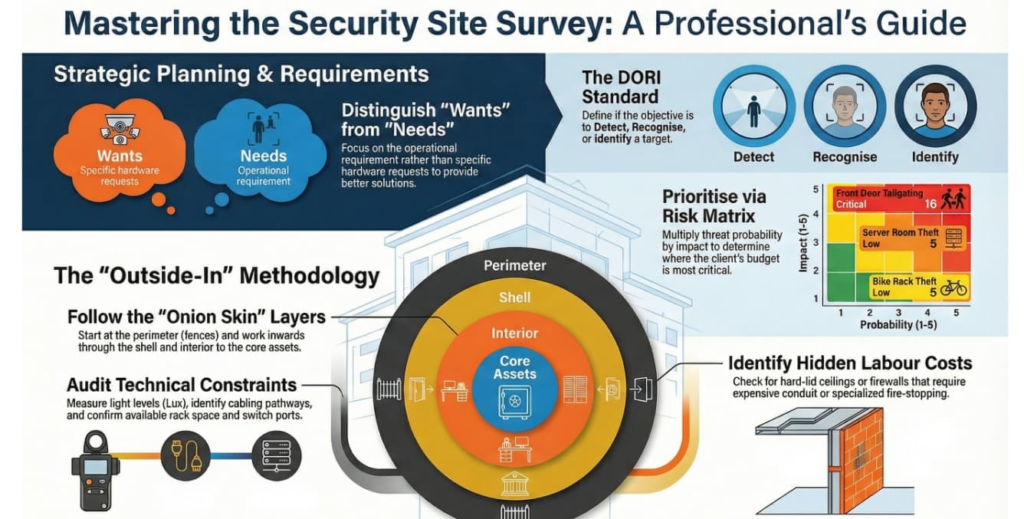
- Distinguish between a client’s “Want” (e.g., “I need 50 cameras”) and their “Need” (e.g., “I need to stop theft”).
- Execute the “Outside-In” survey methodology to ensure no vulnerability is missed.
- Measure critical infrastructure constraints: Lighting (Lux), Cabling Pathways, and IDF capacity.
- Create a “Risk Assessment Matrix” to prioritize budget.
2. The “XY Problem” (Consultative Sales)
Most clients are bad at designing security. They will say: “I want a camera on this pole.”
If you just say “Okay,” you are an Order Taker, not a Consultant.
The Consultant’s Approach:
- Client: “I want a PTZ camera here.”
- You: “What are you trying to see?”
- Client: “I want to see license plates at the gate.”
- You: “A PTZ is the wrong tool (it might be looking the wrong way). You need a dedicated LPR camera.”
The Golden Question: “What is the Operational Requirement?”
Do they need to Detect (Something happened), Recognize (It was a man in a red shirt), or Identify (It was Steve Smith)?
3. The Survey Methodology: “Outside-In”
Never start in the server room. Start at the edge of the property and work your way to the asset. This is the “Onion Skin” theory of defense.
Layer 1: The Perimeter (The Fence)
- Look for: Holes in fences, dark corners, overhangs where people can climb.
- Tech: LPR at gates, Thermal along fences, Intercoms.
Layer 2: The Shell (The Building Exterior)
- Look for: Doors propped open, glass windows near handles, loading docks.
- Tech: Door Contacts, Glass Break sensors, Card Readers.
Layer 3: The Interior (Hallways/Common Areas)
- Look for: Chokepoints (places everyone must walk through).
- Tech: Overview cameras, Motion sensors.
Layer 4: The Core (The Asset)
- Look for: The Server Room, The Safe, The CEO’s Office.
- Tech: Biometrics, Dual-Authentication (Card + Pin), 24/7 Recording.
4. Assessing Infrastructure (The Hidden Costs)
The most expensive part of a job is not the camera; it is the Labor and Wire. You must check these three things during the survey or you will lose money.
- Lighting (Lux Levels):
- Turn off the lights (or go at night). Use a Lux Meter app on your phone.
- Result: If it’s 0 Lux, you need to budget for External IR Illuminators or White Light.
- Cable Pathways:
- Look up. Is it a drop ceiling (Easy)? Or open concrete / hard lid (Hard)?
- The Conduit Trap: Do not assume you can drill through a firewall. You might need expensive fire-stopping material or a dedicated conduit runner.
- IDF / Server Room Capacity:
- Open the rack. Is there 1U of space for your NVR?
- Is there a UPS (Battery Backup)?
- Crucial: Are there open ports on the switch? If the switch is full, you have to buy a new switch.
5. The Risk Matrix (Budgeting)
Clients never have enough money for everything. You help them decide what to cut using a Risk Matrix.
| Risk Scenario | Probability (1-5) | Impact (1-5) | Score (P x I) | Priority |
| Server Room Theft | 1 (Low) | 5 (Critical) | 5 | Low |
| Bike Theft in Parking | 5 (High) | 1 (Annoyance) | 5 | Low |
| Front Door Tailgating | 4 (High) | 4 (High) | 16 | CRITICAL |
- Pitch: “Mr. Client, we can cut the bike rack camera to save money, but we cannot cut the Front Door biometrics because that is your highest risk score.”