Back to: Advanced Physical Security Integration (APSI)
Lesson 1.3: Electrical Basics for Integrators
Module: 1 – Foundations of Physical Security Architecture
Prerequisites: None
Estimated Time: 45–60 Minutes
1. Learning Objectives
By the end of this lesson, you will be able to:
- Define Voltage (V), Current (I), Resistance (R), and Power (P).
- Apply Ohm’s Law ($V = I x R) and the Power Formula (P = V x I) to real-world hardware.
- Explain the relationship between Wire Gauge (AWG) and distance.
- Calculate Voltage Drop to prevent device failure on long cable runs.
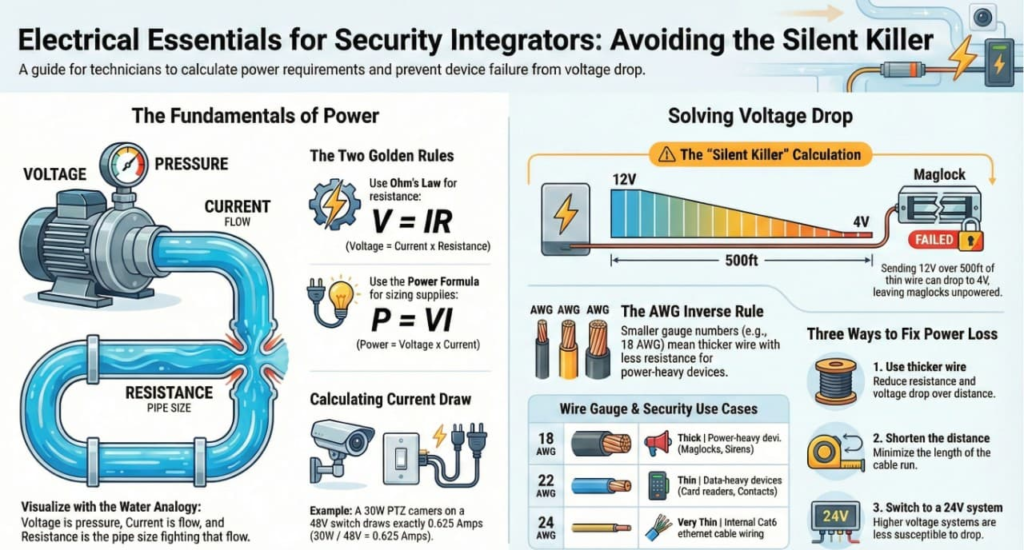
2. The “Water Analogy” (Visualizing Electricity)
Electricity is invisible, which makes it hard to troubleshoot. To understand it, imagine water flowing through a pipe.
| Electrical Term | Symbol | Unit | Water Analogy |
| Voltage | V | Volts | Water Pressure. The force pushing the water. A 24V system has more “push” than a 12V system. |
| Current | I | Amps | Water Flow. The volume of water moving. A maglock needs a lot of flow (Amps); a card reader needs very little. |
| Resistance | R | Ohms ($\Omega$) | Pipe Size/Clog. Anything that fights the flow. A thin wire has high resistance (skinny pipe); a thick wire has low resistance (fat pipe). |
| Power | P | Watts | Work Done. The result of the pressure and flow (e.g., turning a water wheel). |
3. The Two Golden Rules
Rule 1: Ohm’s Law
Describes the relationship between Pressure, Flow, and Resistance.
V = I x R
- Interpretation: If you increase Resistance (R) by using a thin wire, you lose Voltage (V) if the Current (I) stays the same.
Rule 2: The Power Formula
Describes how much energy a device consumes. This is crucial for sizing power supplies.P = V x I
(Or: Watts = Volts x Amps)
- Practical Example:You are installing a PTZ Camera. The datasheet says it consumes 30 Watts. Your switch provides 48 Volts. How many Amps does it draw? I = P / V I = 30 / 48 = 0.625 Amps
4. Wire Gauge (AWG) & Distance
In the US/Imperial system, wire thickness is measured in AWG (American Wire Gauge).
- The Counter-Intuitive Rule: The smaller the number, the thicker the wire.
- 18 AWG: Thick. Used for power (Maglocks, Sirens).
- 22 AWG: Thin. Used for data (Card readers, Door contacts).
- 24 AWG: Very thin. Used inside Cat6 ethernet cable.
- Why it matters: Thicker wire has less Resistance.
- Think of a 4-lane highway (18 AWG) vs. a 1-lane dirt road (24 AWG). Traffic (Current) flows easier on the highway.
5. The Silent Killer: Voltage Drop
This is the #1 reason devices fail in the field.
The Problem:
Wire is not a perfect conductor; it has resistance. As electricity travels down a long wire, it loses “pressure” (Voltage). If you send 12V down a 500-foot wire, you might only get 10V at the end.
The Scenario:
You install a Maglock that requires 12 Volts DC and draws 0.5 Amps. It is located 500 feet away from the power supply. You use thin 22 AWG wire.
- Step 1: Find Resistance of the Wire.
- Standard 22 AWG wire has a resistance of 16 Omhs per 1,000 ft.
- Note: The current goes to the lock and back to the supply. So 500ft distance = 1,000ft of wire.
- Total Resistance R = 16 Omhs.
- Step 2: Calculate Voltage Drop (V_{drop} = I x R).
- $V_{drop} = 0.5 Amps} x 16 Omhs = 8 Volts
- Step 3: The Result.
- Source (12V) – Drop (8V) = 4 Volts at the lock.
- Outcome: The lock will not engage. The door remains open.
The Solution:
- Shorten the distance: Move the power supply closer.
- Thicken the wire: Use 18 AWG (Resistance is only approx 6 Omhs per 1,000ft).
- $New V_{drop} = 0.5 x 6 = 3V.
- $12V – 3V = 9V$. (Still might be too low, but better).
- Increase Source Voltage: Use a 24V system (Percentage of loss is lower).
6. Field Tips for Integrators
- Doubling Up: If you are stuck with a thin cable run and have spare strands (e.g., using a Cat6 cable for power), twist two pairs together. Two thin wires act like one thick wire, reducing resistance.
- Inrush Current: A device might say “Current Draw: 500mA”. But when it first turns on (startup), it might spike to 1000mA for a split second. Always budget 25% overhead on your power supplies.
- AC vs DC:
- DC (Direct Current): Suffers from voltage drop heavily. Good for short distances.
- AC (Alternating Current): Travels long distances better. Often used to power cameras/heaters, which then convert to DC internally.