Back to: Advanced Physical Security Integration (APSI)
Lesson 1.4: Power Budgets & Battery Backup
Module: 1 – Foundations of Physical Security Architecture
Prerequisites: Lesson 1.3 (Ohm’s Law)
Estimated Time: 45–60 Minutes
1. Learning Objectives
By the end of this lesson, you will be able to:
- Calculate the total load (Amps) for a system to select the correct Power Supply Unit (PSU).
- Apply the “25% Headroom” rule to prevent PSU failure.
- Determine the required Battery Capacity (Ah) to keep a system running during a blackout.
- Distinguish between High Voltage (110/220V) and Low Voltage (12/24V) and know when you need a licensed electrician.
2. Sizing the Power Supply Unit (PSU)
A common mistake is buying a power supply that barely covers the load. This leads to overheating and premature failure.
The Process:
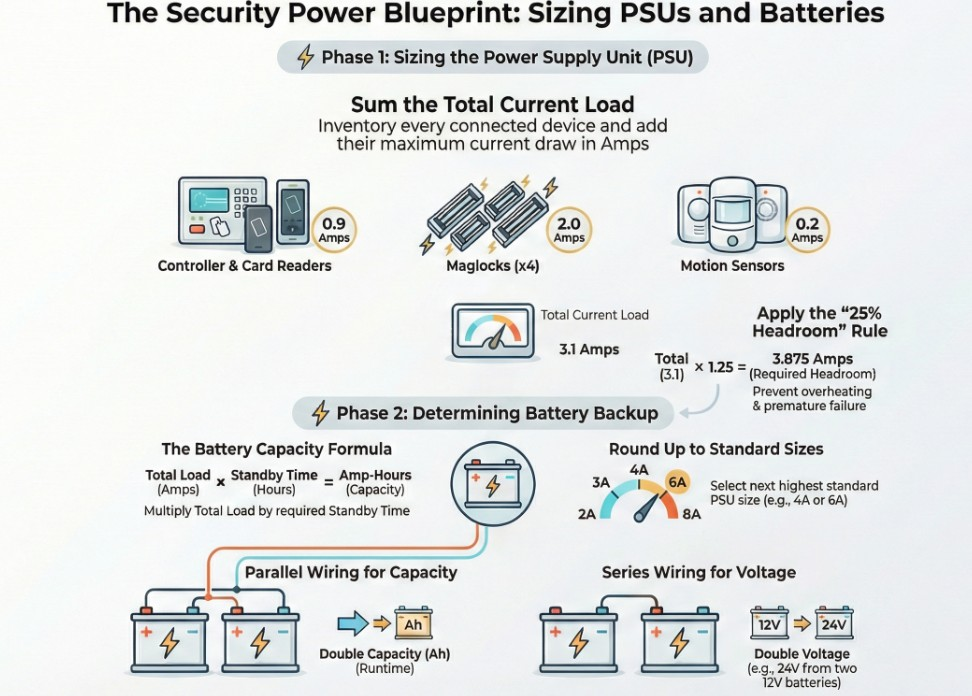
- Inventory: List every device connected to the PSU.
- Sum the Current: Add up the Max Current Draw (Amps) for each device.
- Apply Headroom: Multiply the total by 1.25 (25% safety margin).
- Select PSU: Round up to the nearest standard PSU size (e.g., 2A, 4A, 6A, 10A).
Example Calculation:
You are powering a 4-door access control panel.
- Controllers (x1): 0.5 Amps
- Card Readers (x4): 0.1 Amps each = 0.4 Amps
- Maglocks (x4): 0.5 Amps each = 2.0 Amps
- Motion Sensors (x4): 0.05 Amps each = 0.2 Amps
Total Load: $0.5 + 0.4 + 2.0 + 0.2 = 3.1 Amps
Safety Margin:
3.1 Amps x 1.25 = 3.875 Amps
Selection:
You cannot use a 3A supply. You need a 4A or 6A Power Supply.
3. Battery Backup (Standby Power)
Security systems must work when the building loses power. We use lead-acid batteries (similar to car batteries) measured in Amp-Hours (Ah).
What is an Amp-Hour?
One “Amp-Hour” means the battery can provide 1 Amp of current for 1 Hour before dying.
- Or 0.5 Amps for 2 Hours.
- Or 2 Amps for 0.5 Hours.
The Formula:
$$Battery Capacity (Ah) = Total Load (Amps) \times Desired Standby Time (Hours)
Scenario:
Using the 4-door system above (Load = 3.1 Amps).
The Fire Marshal requires the system to stay alive for 4 Hours during an outage.
Capacity = 3.1 Amps x 4 Hours = 12.4 Ah
Selection:
Standard battery sizes are 7Ah, 12Ah, 18Ah, and 40Ah.
A single 12Ah battery is slightly too small (12.4 needed). You should use two 7Ah batteries in parallel (Total 14Ah) or one 18Ah battery.
4. Wiring Batteries: Series vs. Parallel
Sometimes you need more voltage (24V), and sometimes you need more capacity (Ah).
- Series Wiring (Voltage Adder):
- Connect Positive (+) to Negative (-).
- Result: Voltage doubles, Amps stay the same.
- Use Case: Creating a 24V system using two 12V batteries.
- Parallel Wiring (Capacity Adder):
- Connect Positive (+) to Positive (+) and Negative (-) to Negative (-).
- Result: Voltage stays the same, Amps (Capacity) doubles.
- Use Case: Extending runtime from 4 hours to 8 hours.
5. High Voltage vs. Low Voltage
Integrators generally live in the “Low Voltage” world, but you must respect the boundary.
- Low Voltage (< 50V):
- Includes: 12VDC, 24VAC, PoE (48V).
- Safety: Generally safe to touch (won’t kill you, might tingle).
- Regulation: In most jurisdictions, you do not need a full electrical license, but you must follow the National Electrical Code (NEC) Article 725 (Class 2 Circuits).
- High Voltage (> 110V):
- Includes: Wall outlets (120V/220V), lighting circuits.
- Safety: Lethal. Do not touch.
- Rule: Never run high voltage and low voltage in the same conduit. The high voltage creates electromagnetic interference (induction) that disrupts data signals and can fry sensitive electronics.