Back to: Advanced Physical Security Integration (APSI)
Lesson 3.3: The DORI Standard & Pixel Density
Module: 3 – Video Surveillance (VMS & CCTV)
Prerequisites: Lesson 3.1 (Hardware) & Lesson 3.2 (Image Quality)
Estimated Time: 45–60 Minutes
1. Learning Objectives
By the end of this lesson, you will be able to:
- Define the IEC 62676-4 “DORI” Standard: Detection, Observation, Recognition, Identification.
- Calculate Pixels Per Foot (PPF) or Pixels Per Meter (PPM) to prove a camera design works before installation.
- Debunk the “Enhance!” myth by explaining the limits of Digital Zoom.
- Design a camera layout that guarantees face identification at a specific distance.
2. What is DORI?
For years, clients would ask: “Can I see a face?” The integrator would say “Yes,” install a camera, and then the client would complain the image was blurry. This happened because “see a face” is subjective.
The DORI Standard (based on IEC 62676-4) turns this subjectivity into Math. It defines exactly how many Pixels Per Foot (PPF) cover the target object.
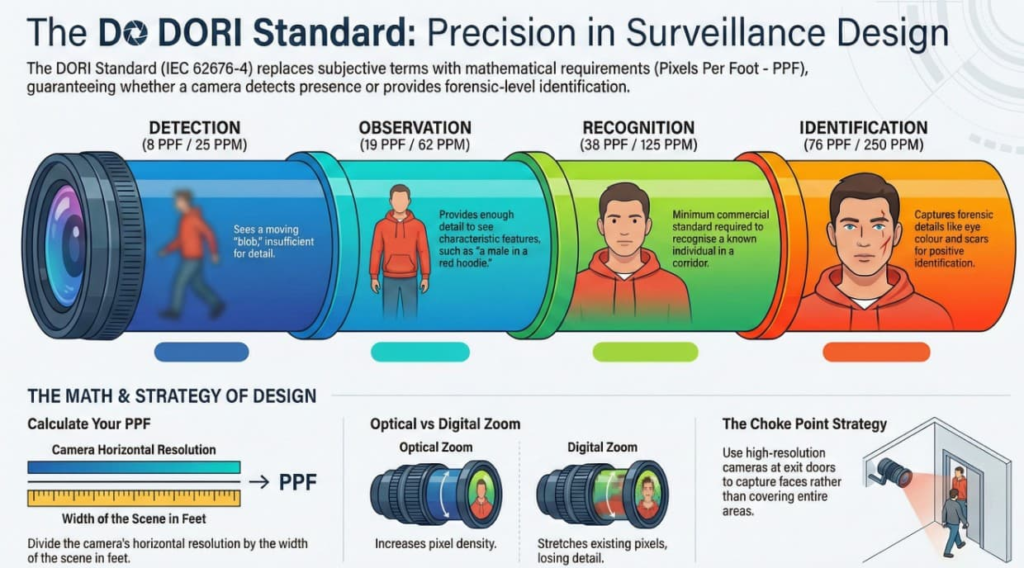
3. The 4 Levels of DORI
Level 1: Detection (8 PPF / 25 PPM)
- Goal: To detect that something is present.
- What you see: A moving blob. You can tell if it is a human or a vehicle. You cannot tell age, gender, or clothing details.
- Use Case: Perimeter fence lines, parking lot wide shots, construction sites.
- Why use it: It allows you to use one camera to cover a massive area cheaply.
Level 2: Observation (19 PPF / 62 PPM)
- Goal: To see characteristic details.
- What you see: “A male wearing a red hoodie and blue jeans.”
- Use Case: Monitoring general flow in a lobby or school hallway.
- Limitation: You cannot identify who the person is unless you already know them.
Level 3: Recognition (38 PPF / 125 PPM)
- Goal: To recognize a known individual.
- What you see: “That is Steve from Accounting.”
- Use Case: Employee entrances, secure office corridors.
- Standard: This is the minimum standard for most commercial security indoors.
Level 4: Identification (76 PPF / 250 PPM)
- Goal: To identify an unknown individual beyond a reasonable doubt (Forensic Evidence).
- What you see: Facial scars, eye color, tattoos.
- Use Case: Bank tellers, Casino gaming tables, Passport control, Police interrogation rooms.
- Cost: Requires high resolution and narrow field of view (many cameras needed).
4. The Math: Calculating Pixel Density
To guarantee you hit “Identification” quality, you must calculate the Pixels Per Foot (PPF).
The Formula:
PPF = Horizontal Resolution of Camera/Width of the Scene (Field of View)
Example Scenario:
You are installing a 1080p Camera (1920 pixels wide).
You aim it at a gate. The view at the gate is 20 feet wide.
Step 1: Get the Resolution.
- 1080p = 1920 horizontal pixels.
Step 2: Get the Scene Width.
- Width = 20 feet.
Step 3: Divide.
- 1920 / 20 = 96 PPF.
Verdict:
- 96 PPF is higher than the 76 PPF required for Identification.
- Pass: This camera will capture forensic details of anyone at that gate.
5. The “Enhance” Myth (Digital vs. Optical Zoom)
Clients often think they can zoom in on recorded video like on CSI. You cannot create pixels that do not exist.
- Optical Zoom (The Lens): Moving the glass lens to magnify the light before it hits the sensor. This increases PPF. (True Zoom).
- Digital Zoom (The Software): Stretching the existing pixels. If you have 20 PPF (Observation) and you digital zoom 4x, you just have bigger, blockier pixels. You do not gain facial detail.
Field Tip:
If a client says, “I want one camera to see the whole parking lot (Detection), but I want to be able to read a license plate at the back (Identification),” you must explain the physics.
- Option A: Use a specialized 30MP Multi-sensor camera.
- Option B: Use two cameras—one Wide (Context) and one Telephoto (Target).
6. Design Exercise: The “Choke Point” Strategy
Because high PPF (Identification) is expensive (requires more cameras), smart integrators use Choke Points.
- Don’t try to get Identification quality everywhere in the warehouse (Level: Detection).
- Do create an Identification zone at the Exit Door (Level: Identification).
- Logic: The thief might be a blurry blob while stealing the box, but he must walk through the door to leave. We catch his face there.