Back to: Advanced Physical Security Integration (APSI)
0
Lesson 12.1: Maintenance Contracts & Recurring Monthly Revenue (RMR)
Module: 11 – The Business of Security
Prerequisites: Lesson 9.3 (Commissioning)
Estimated Time: 45–60 Minutes
1. Learning Objectives
By the end of this lesson, you will be able to:
- Define RMR (Recurring Monthly Revenue) and explain why it increases the valuation of a security business.
- Structure a Service Level Agreement (SLA) with tiered response times (Silver/Gold/Platinum).
- Distinguish between a “Warranty” (Manufacturer’s promise) and a “Service Contract” (Integrator’s labor).
- Calculate the profitability of a Preventative Maintenance (PM) visit.
2. The “Holy Grail”: One-Time vs. Recurring Revenue
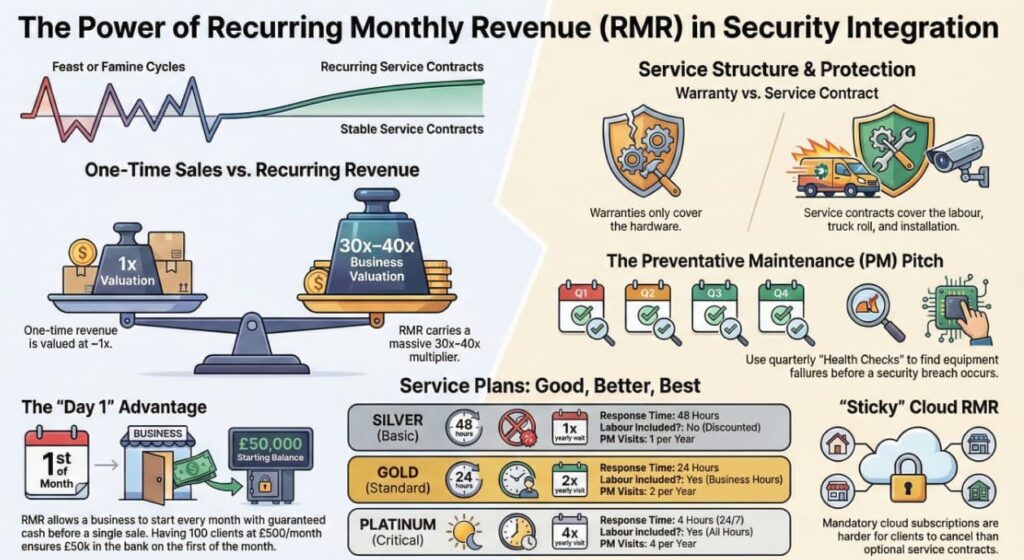
Most integrators operate on a “Feast or Famine” cycle.
- Construction (One-Time): You sell a $100k system. You make $20k profit. Next month, you start at $0.
- RMR (Recurring): You charge the client $500/month for support.
- The Magic: If you have 100 clients, you start every month with $50,000 in the bank before you sell a single camera.
- Valuation: When selling a business, One-Time revenue is valued at ~1x. RMR is valued at ~30x–40x.
3. Types of Contracts
A. The SSA (Software Support Agreement)
- What it covers: Firmware updates, VMS software upgrades (e.g., Genetec Advantage or Milestone Care Plus), and Cybersecurity patching.
- Why buy it? “Mr. Client, if you don’t pay this, you don’t get the new AI features, and your system becomes vulnerable to hackers (Lesson 7.4).”
- Cost: Usually 15-20% of the software license cost per year.
B. The Preventative Maintenance (PM) Agreement
- What it is: A scheduled “Health Check” (usually quarterly or bi-annually).
- The Checklist:
- Clean Lenses: Spider webs and dust ruin night vision (IR reflection).
- Focus Check: Building vibrations shift cameras out of focus over time.
- Battery Test: Check the UPS and Alarm Panel batteries.
- Storage Audit: Verify the NVR is actually recording 30 days (as calculated in Lesson 9.2).
- The Pitch: “We find the failure before you have a break-in.”
C. The SLA (Service Level Agreement)
This guarantees Response Time, not a fix.
- Standard (No Contract): “We will get to you when we can (maybe 3 days).”
- Silver: “Next Business Day Response.”
- Gold: “4-Hour Response (Business Hours).”
- Platinum: “4-Hour Response (24/7/365).”
4. Structuring the Tiers (The “Good, Better, Best” Model)
Never just give one price. Give three options to guide the client to the middle.
| Feature | Silver (Basic) | Gold (Standard) | Platinum (Critical) |
| Response Time | 48 Hours | 24 Hours | 4 Hours (24/7) |
| Labor Included? | No (Discounted Rate) | Yes (Business Hours) | Yes (All Hours) |
| PM Visits | 1 per Year | 2 per Year | 4 per Year |
| Parts | Billable | Billable | Included (Insurance) |
| Price | $ | $$ | $$$$ |
- Note on “Parts Included”: This acts like insurance. If a camera dies, you replace it for free. You must price this high to cover the risk.
5. Warranty vs. Service Contract
Clients often say: “Why do I need a contract? The camera has a 3-year warranty!”
The Response:
- Manufacturer Warranty: “They will ship me a free cardboard box with a new camera in it. They will not pay for the truck, the lift, the technician to drive here, the labor to climb the pole, or the programming time to set it up.”
- Service Contract: Covers the Labor and the Truck Roll.
- Analogy: Your car has a warranty. Does that mean oil changes and tire rotations are free? No.
6. Cloud RMR (VSaaS / ACaaS)
The easiest RMR is reselling Cloud services (Verkada, Brivo, Alarm.com).
- Model: You buy the license for $100. You sell it for $150.
- Benefit: Sticky. The client cannot cancel without losing their security. Service contracts are optional; Cloud subscriptions are mandatory.