Back to: Advanced Physical Security Integration (APSI)
Lesson 12.2: Sales Strategy & Estimating
Module: 11 – The Business of Security
Prerequisites: Lesson 10.4 (Scope of Work) & Lesson 11.1 (RMR)
Estimated Time: 45–60 Minutes
1. Learning Objectives
By the end of this lesson, you will be able to:
- Construct a “Bottom-Up” estimate that covers Labor, Materials, Overhead, and Margin.
- Differentiate between “Markup” and “Gross Margin” (the #1 math error that bankrupts integrators).
- Identify the “Pain Funnel” sales technique to move clients from “Interest” to “Action.”
- Apply “Value Engineering” to reduce a quote’s price without killing your profit.
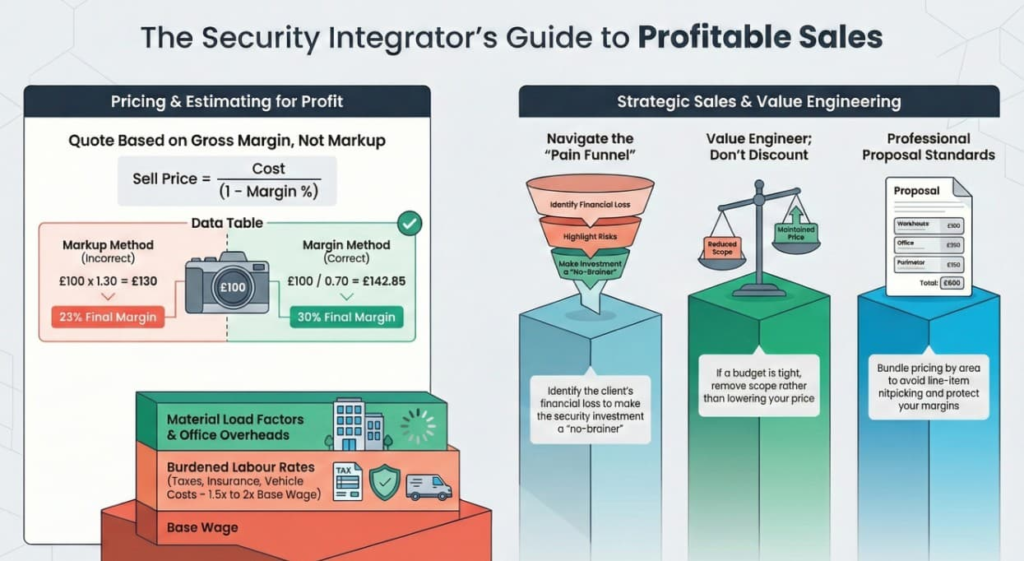
2. The Estimating Math: Markup vs. Margin
Many people use these terms interchangeably. They are mathematically different.
- Scenario: A camera costs you $100. You want to make 30%.
- Markup Method (Wrong for Profit Targets):
- $100 x 1.30 = $130.
- Profit is $30.
- Margin is 30/130 = 23%. (You missed your 30% target).
- Margin Method (Correct):
- Formula: Sell Price = Cost/(1 – Margin) %.
- 100/(1 – 0.30) = 100/0.70 = $142.85.
- Profit is $42.85.
- Margin is 42.85/142.85 = 30%.
Rule: Always quote based on Gross Margin.
3. The “Bottom-Up” Estimate
Never guess. Build the quote brick by brick.
- Materials (The Hard Costs):
- Camera, Mount, License, SD Card.
- Load Factor: Add 3-5% for “Sundries” (screws, tape, zip ties).
- Labor (The Variable Risk):
- Hours x Hourly Cost (Burdened Rate).
- Burdened Rate: This is not what you pay the tech ($30/hr). It includes taxes, insurance, truck, and tools. Usually 1.5x to 2x the wage (e.g., $60/hr).
- Direct Expenses:
- Lift Rental ($500/day).
- Permits.
- Subcontractors (Cabling guys).
- Overhead: The cost to keep the lights on at your office (Rent, Sales Commissions, Admin).
- Profit: The reward for taking the risk.
4. Sales Strategy: The “Pain Funnel”
Clients don’t buy cameras; they buy solutions to problems.
The Sandler Pain Funnel:
Don’t pitch features (4K, WDR). Ask questions to find the hurt.
- “Tell me more about that.”
- Client: “We had a break-in last week.”
- “Can you be more specific?”
- Client: “They stole copper wire from the yard.”
- “How long has this been a problem?”
- Client: “It’s the third time this month.”
- “What has that cost you?” (The Money Question).
- Client: “About $15,000 in materials and delays.”
- “How much is it worth to fix it?”
- Closing: If you pitch a $5,000 thermal camera system, it is a “No-Brainer” compared to the $15,000 loss.
5. Value Engineering (Cutting Cost, Not Throat)
The client says: “Your quote is $20k. My budget is $15k.”
Do NOT simply lower your price. If you drop the price but keep the scope, you admit you were overcharging them.
Instead, remove scope to match the budget:
- “Okay, we can get to $15k. To do that, we will switch from the 4K cameras to 2MP cameras in the hallways.”
- “We can remove the 5-Year Warranty and go to a 1-Year.”
- “We can remove the Lift Rental if your team can provide access.”
Psychology: This maintains the integrity of your pricing.
6. The Proposal Document
A quote should look like a legal document, not a napkin sketch.
- Cover Page: Professional photo of their building (use Google Earth if needed).
- Scope of Work (Lesson 10.4): Clearly defined.
- Investment Summary: One clear number. (Do not line-item every screw; it invites nitpicking. Bundle by room or area).
- Terms: “50% Deposit required to order materials.” (Cash flow is king).